Showing posts with label trang. Show all posts

Sunday, 21 February 2016

Tuk Tuk Tales in Trang

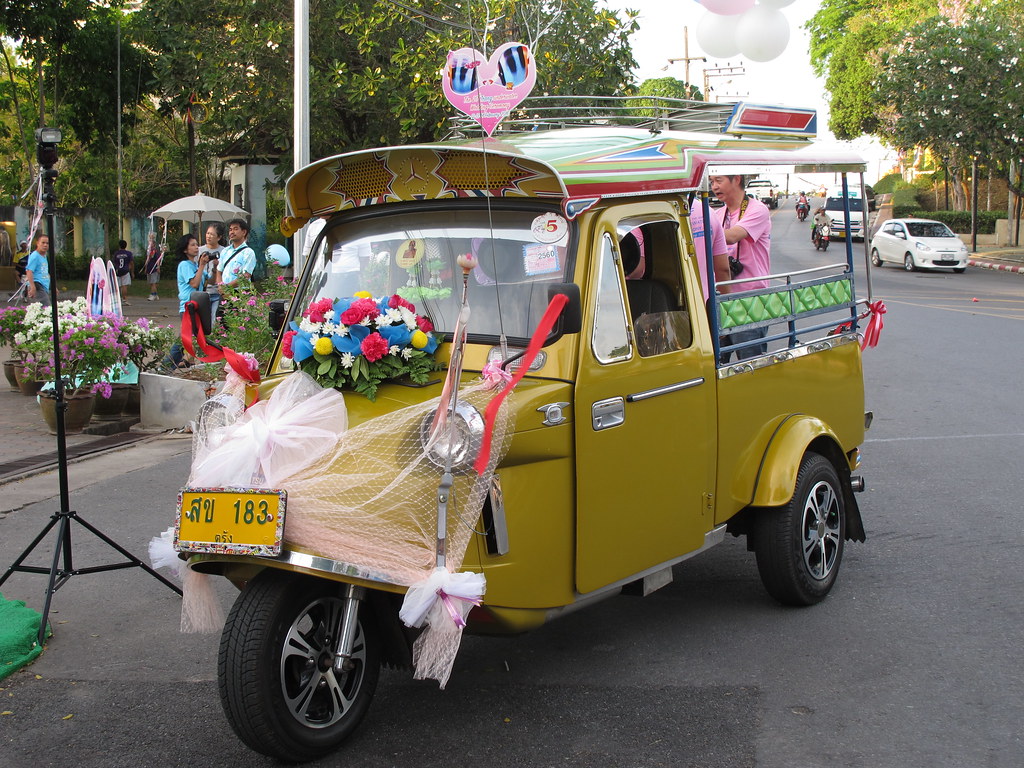
Immaculately restored tuk-tuk  (R Eime)
The ubiquitous auto-rickshaw, known lovingly throughout Thailand as the tuk-tuk, is a cheap form of personal transport and taxi-cab. Its name is derived from the sound made by the little two-stroke motor, which in English would be more familiar as ‘putt-putt’.

Here in Trang, the vast majority of tuk-tuks are owned by their drivers as opposed to Bangkok, where the uniform colour indicate they are company owned. Many have been in the same hands for decades.

To demonstrate their much-loved place in Thai urban folklore,
bridal couples in the Trang 20th Anniversary Underwater Wedding Ceremony
were photographed with immaculate collector examples in prominent city locations.  (R Eime)
For the ‘spotters’ among us, the design of the DKA Midget began in 1957 in the Daihatsu factory in Japan. The idea was for a compact, economical vehicle for light duties in the many narrow streets of Japanese cities. After an appearance on a TV show, the idea took off and soon the tiny taxis were finding their way onto streets, alleys and workplaces all around the world.

They even enjoyed some limited success in the USA as a light freight and delivery vehicle. They were even used around large factory sites like Boeing for transport. The tuk-tuk taxi was marketed in the USA as the Daihatsu Trimobile AP (all purpose) ‘Safari Wagon’

1959 US sales brochure for the 'Trimobile'
Trang is one of the few places left in the world where you will easily see the early MP5-derived 'frog head' models that trace their history and design back to the originals from the late 1950s.

The tuk-tuk is powered by an air-cooled 305cc 2-stroke, single cylinder engine with a power output of around 9kW. In many places of the world, upgrades to LPG are available. This was in response to some congested regions where the little 2-strokes can get a bit smoky, especially if not properly maintained.

Kuhn San has owned his frog-head tuk-tuk for more than 30 years, diligently
painting and repainting it in the original factory colour. Kuhn San
 is not so meticulous about the trimmings, with a Mazda
steering wheel, Honda stickers and a Toyota bonnet badge. (R Eime)
While cheap and effective forms of urban transport remain in demand, you can expect to see tuk-tuks on the streets of Thai cities for some time to come.

Tuesday, 16 February 2016

Consuming Trang: A Tasty Bake


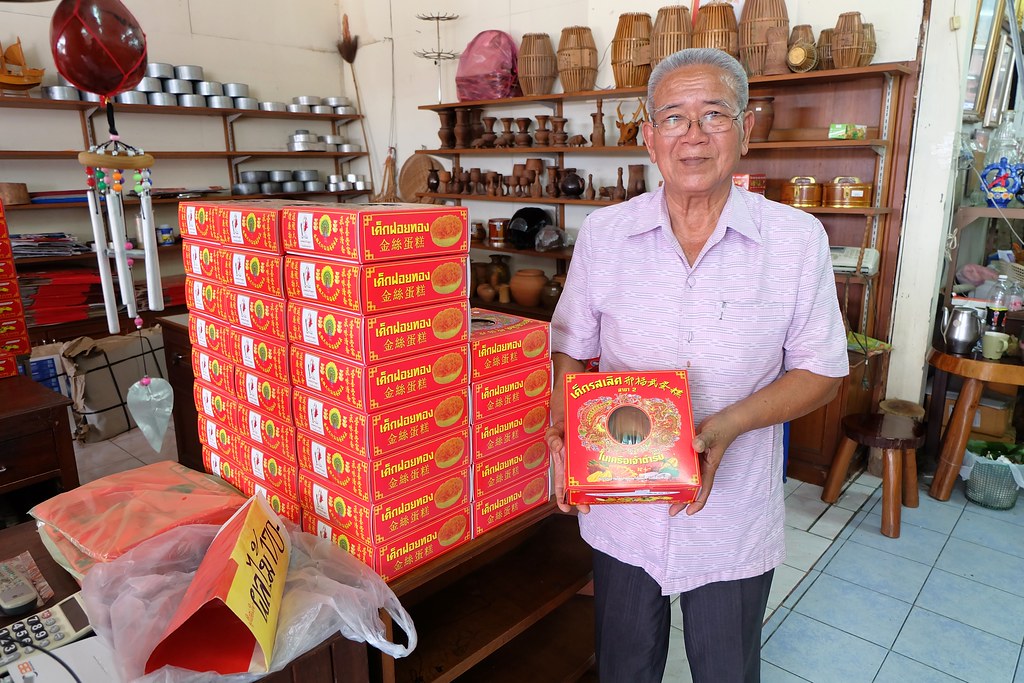
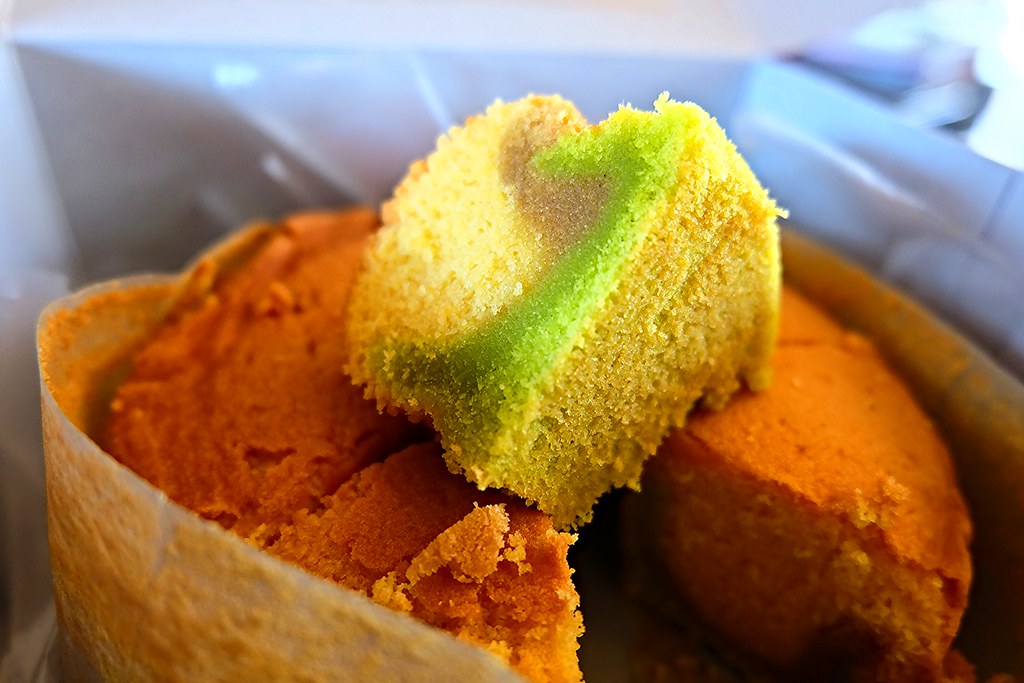
The famous sweet cake from Trang is a Thai nationwide sensation. Roderick Eime samples this delightful treat.

When Kuhn Yee Keng was just 19, he started baking cakes in the family kitchen in Trang. In 1956, the busy kitchen turned out just 20 cakes a day using tough manual processes. Now 60 years later, his tasty fruit cakes are sought after all over Thailand, not just in his home province of Trang.

Kuhn Yee now operates five stores across Trang, producing up to 800 of the 500g cakes on a busy day and helped by family members who must often ferry finished cakes from one store to another during busy periods.

DSCF7533

“Because we do not preserve in rum like many traditional fruit cakes,” Kuhn Yee tells me via my guide Suree, “they are best eaten within three days, but can stay fresh for up to a week.”

This alcohol-free process also makes the cake attractive amongst the sizeable Muslim population who live predominantly in the south of the country.

While the recipe was once a closely guarded secret, Kuhn Yee is now happy to share his famous recipe on one of his many TV segments on Thai television.

Main ingredients include eggs, sugar, butter and blended fruits such as mango, tomato, plum, raisins, banana and nuts like cashews.

These famous ‘tasty bake’ cakes cost around 50 baht and can be enjoyed any time of the year, but are an ideal complement to tea or coffee.

More information about travel in Trang (Official Site)

Related: Trang offers tasty Thai treats for food lovers


Saturday, 16 July 2011

Trang - the most beautiful part of Thailand I've never heard of.

Here's a funny thing ... I've lived in Amazing Thailand many a year, and -- being a travel writer -- like to think that nothing, NOTHING, escapes my attention when it comes to travel and tourism.

So when my cousin (Hello, John) who lives in Africa mentioned he was coming to here and wanted some tips on good places to stay in Trang, there was something of a pause. 'Hello?' he said, not wanting to spend more time on this international call which he was paying for than necessary.

'Trang, you say?' I said, fumbling for my map of Thailand. I quickly scanned the country, up and down. No bloody Trang anywhere.

'You know, near Phuket, but better, nicer.'

'Oh, that Trang,' I said, finally seeing the little dot down south west, on the edge of Phang Nga Bay. 'Sorry, it's been a while since I've been, so whatever tips I have would probably be out of date. Better off checking Trip Advisor, mate.'

At that point I made a note to visit Trang, one of few little corners of Thailand I'd not been to. Ever. Why not?

So it was with great excitement that we boarded the overnight train from Bangkok's quite grandiose-looking Hualampong Station. The 1st class sleeper trains are excellent in Thailand, and a great way to have amiable chats with locals, maybe a medicinal sip or two of local whiskey if they offer it, and wait for the attendant to come round and make your bed. Comfy enough bunks, with curtains for privacy. (Oh, better take a spare bottle of Sam Song Whiskey if you want a really good night's sleep.)

The morning light showed us to be in interesting tropical countryside with palm trees, sugar cane, the odd karst upthrust. After around 12 or more hours, around breakfast time, we pulled into Trang. There was a nice poetry to this, because the town is named Trang after the Malay word 'terang' which means light, which is when the trading vessels always used to arrive here.

You see, in its former life, 900-years-old Trang was part of the Kedahan-Malay kingdom, then became an important international trading port for Thailand, located on the Andaman Sea, just north of Malaysia.

The Muslims settled along the coast for trading purposes. The Chinese stuck to the town itself, where the commerce was. And the Thais were somewhere in between.

A dugong ... an underwater wombat?
The town today doesn't immediately scream Major International Trading Port. In fact it doesn't even whisper it. The railway station is a small affair with green gables, and nearby the shabby Ta Klang market plies its trade from 1am each morning till just after breakfast time. Stalls groan with mangos, durian and dragonfruit. An unimpressive clock tower forms one roundabout in town, but that is easily upstaged by the roundabout featuring 20 ... um, what the hell are those things?

Closer inspection reveals them to be dugongs, which are strongly associated with the area, but numbers are falling fast because they are exceptionally dumb and slow, frankly, and no match for a hungry local's harpoon.

Another statue is of former governor Phraya Ratsadanupradit Mahison Phakdi, also known curiously as Khaw Sim Bee na Ranong, who had the original vision to make this into a seaport. He was also responsible for introducing the rubber tree to Thailand from Malaya in 1899. 


Think of him as Thailand's equivalent of Singapore's Sir Henry Ridley. Thailand went on to becoming one of the largest suppliers of rubber (and rubbers!) in the world, jing jing.

A Robinson's department store talks of a little prosperity in the town . But most travellers don't hang around in town. They want to get out to some of the province's 46 islands (which include the beautiful Ko Kradan and Ko Ngai, the traditional fishing villages of Ko Muk, and the sea caves of Ko Morakut). As for us, we were met at the station by the Anantara Si Kao's car and whisked off to the fancy resort which I'll blog about soon.

Ko Kradan ... don't you just want to be here now???
Trekking is also popular, with over 20 waterfalls in the area. And diving should be a lot more popular ... the  Chao Mai National Park is home to some of the most awesome dive spots in the world. Ko Kradan is one of these.

But Trang only receives a fraction of the tourists that make it to Phuket or even Krabi. So if you want a quieter time, this is the place to be.

But you'd better go quick. You see, now that I've blogged about it, the crowds are going to be pouring in. You may even see my cousin John ... I recommended he should go to this really beautiful place down south that I know. It's called Trang.


Sunday, 3 July 2011

Coming up in July from Krabi, Trang, Phi Phi and Phuket Thailand

Dear readers,

Painting at Anantara Si Kao
You're in for a treat in July, as I visit a part of Amazing Thailand I've never been before (Trang and Krabi) and revisit some areas I first went to in 1988 (such as Phi Phi Island and Phuket).

Among the hotels, resorts, activities and attractions I'll blog about on Thailand Jing Jing as I criss-cross Phang Nga Bay are:

Anantara Si Kao Resort and Spa, near Krabi
Red Ginger Chic Resort, Ao Nang, Krabi
Pakasai Resort, Ao Nang, Krabi
Bhu Nga Thani Resort and Spa, Railay Bay, Ao Nang
Phi Phi Island Village Beach Resort and Spa
Koh Yao Yai Village
Kayaking through limestone and mangroves in Phang Nga Bay.
Snorkelling on Phi Phi Island
Jungle Splash Water Park, Phuket

I resisted the urge to visit the Ritz Carlton at Pulay Bay where the stunningly beautiful Hangover 2 movie wedding scene was shot, though I did speak to one hotelier whose location was rejected after the producer got seasick!

Many of these blogs will take a wellness angle, with wonderful spa treatments which have me oiled up and steaming and creaming, and some take an eco-angle, kayaking and snorkelling and doing my bit to save your earth.

Oh, by the way, do not call Phi Phi Island part of Phuket. It is part of Krabi province, and a good way to annoy the locals by getting it wrong, jing jing.

Friday, 24 June 2011

The happiness index in Amazing Thailand, the Land of Smiles.

Although it literally translates as 'Land of the Free', Amazing Thailand has long been known as 'The Land of Smiles' for the very good reason that it seems a smile is naturally not very far away from the lips of most Thais.

As any traveller will tell you, you usually receive excellent return on investment every time you offer a smile and a polite greeting to a Thai. (Compare this with trying to get a smile and a hello out of someone passing in the street on a grey winters day in, say, Frankfurt.)

But are Thais really happy people or is this just some sort of cultural defense mechanism?

I've done some rummaging about for you, and there are several answers ...

The Bangkok Post recently published an article that indicated that Thais have grown happier each year since 2008 according to the National Statistical Office who publish a 'Happiness Indicator' each year. The Happiness Index scores have risen nearly 6% since then.

Further, they found the happiest residents on average -- and presumably the largest Thailand smiles -- in Phang Nga (that's south near Phuket, not to be confused with Phangan where the smiles are more to do with mushrooms), followed by Trang (south, near Krabi), Maha Sarakham (no idea, look it up yourself), Narathiwat (deep south) and Tak (halfway between Bangkok and Chiang Mai, and deemed to be the starting point of Northern Thailand).

Now get this ...

In the Happy Planet Index 2009, Thailand ranked 41st of all countries. Hmmm, not very high satisfaction you might think. But look at some other results: UK - 74th! Australia 102nd! USA 114th!

Now any Americans reading this and questioning the methodology, etc, had better listen and listen good. Because here's a second opinion. And not just any opinion, but one from a North Korean Happiness Index report on the internet, so you know it's objective, reliable, impartial and accurate, jing jing.

North Korea ranks China as the happiest country in the world, followed by North Korea 2nd. Last place? The USA. So there you have it.

So look around you ... are people largely smiling or frowning? Now go for a walk down the street and smile at someone ... did you get a big sunny grin in return that threatened to split their cheeks -- or did they threaten to call the cops on you?

If it was the latter, perhaps it's time to travel to Thailand, the land of smiles.