Tuesday, 16 February 2016

Consuming Trang: A Tasty Bake


The famous sweet cake from Trang is a Thai nationwide sensation. Roderick Eime samples this delightful treat.

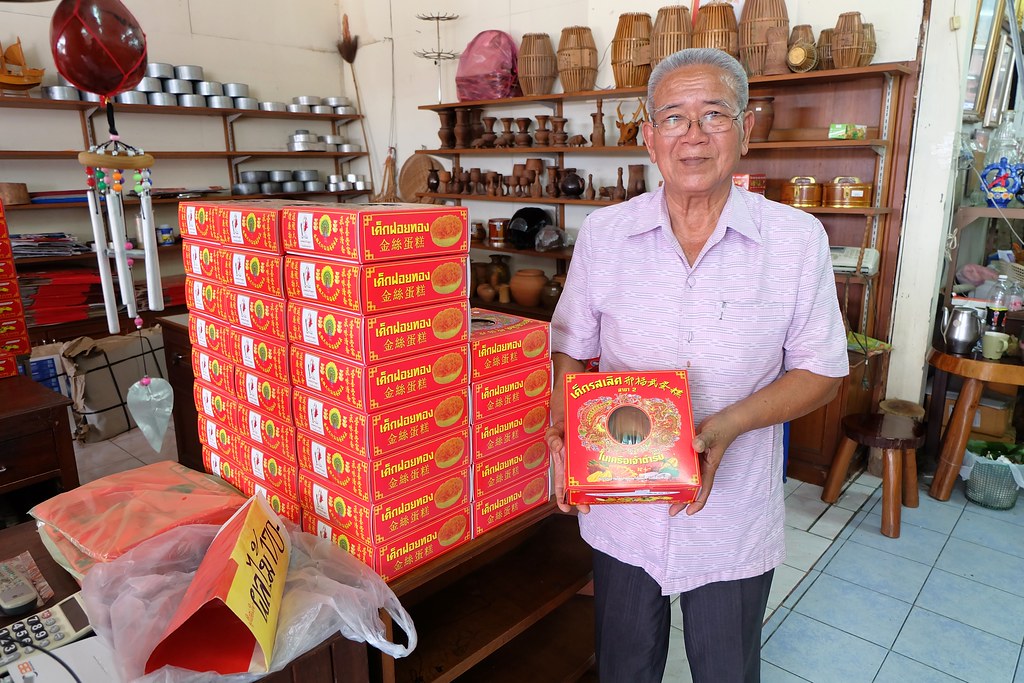
When Kuhn Yee Keng was just 19, he started baking cakes in the family kitchen in Trang. In 1956, the busy kitchen turned out just 20 cakes a day using tough manual processes. Now 60 years later, his tasty fruit cakes are sought after all over Thailand, not just in his home province of Trang.

Kuhn Yee now operates five stores across Trang, producing up to 800 of the 500g cakes on a busy day and helped by family members who must often ferry finished cakes from one store to another during busy periods.

DSCF7533

“Because we do not preserve in rum like many traditional fruit cakes,” Kuhn Yee tells me via my guide Suree, “they are best eaten within three days, but can stay fresh for up to a week.”

This alcohol-free process also makes the cake attractive amongst the sizeable Muslim population who live predominantly in the south of the country.

While the recipe was once a closely guarded secret, Kuhn Yee is now happy to share his famous recipe on one of his many TV segments on Thai television.

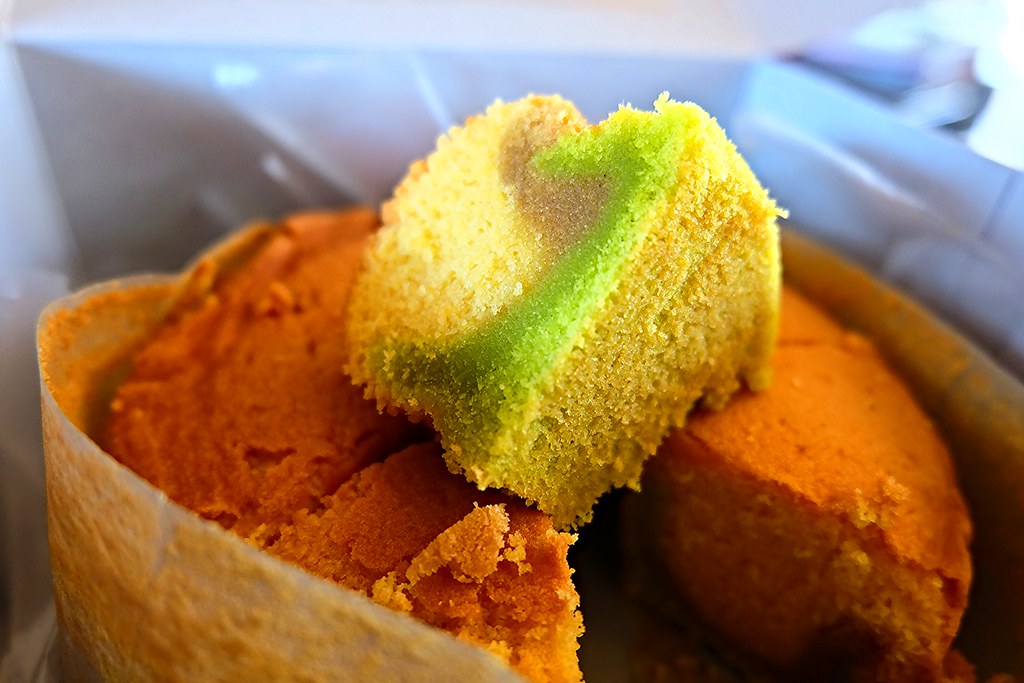
Main ingredients include eggs, sugar, butter and blended fruits such as mango, tomato, plum, raisins, banana and nuts like cashews.

These famous ‘tasty bake’ cakes cost around 50 baht and can be enjoyed any time of the year, but are an ideal complement to tea or coffee.

More information about travel in Trang (Official Site)

Related: Trang offers tasty Thai treats for food lovers


Wednesday, 25 March 2015

Summer in Siam by John Borthwick

Summer in Siam by John Borthwick

"I walked out the door, a bit dazed. I had ten dollars and two not-quite diamonds, and it was summer in Siam." John Borthwick's first day in Thailand seemed far from auspicious — but it has been uphill from then on. Dropping him in the middle of everything from three-day tribal weddings, elephant polo follies and pristine islands to Pattaya's bacchanalian nightlife, Thailand has kept John and his pen constantly on the move.

One of Australia's leading travel authors, John Borthwick has gathered here the best of his years of Thailand adventures, plus a swag of vivid tales from his wanderings in India, Xinjiang, the Himalayas, Borneo, Bali, Laos, Vietnam and the Philippines.

New website: Summer In Siam

Paperback
Bangkok Books
Bangkok 2006
232 pages 395 Baht
ISBN 974-85129-2-4

Tuesday, 9 December 2014

Top 10 Thai Luxury Resorts


NZ Let's Travel magazine recently polled some of the top travel writers about their choice of luxury Thailand resorts. Here's their verdict:

Saturday, 15 November 2014

Two ways to do Phuket - Pool villas or resorts


While I have become a regular to Thailand, my visit to Phuket was the first time I'd stayed in this famously rumbustious resort town. No, I'm not going to dwell on the kaleidoscope of entertainment options assaulting you as you navigate bustling Bangla Road - there are better sites for that information - but rather on choosing appropriate accommodation to suit the kind of relaxation you, you partner and/or family have in mind.

The raucous New Tiger nightclub is one of the 'colourful' venues
along bustling Bangla Road (source: phuket101.net)

To illustrate my point, I stayed two nights in each of two contrasting properties. One, a sprawling 665-room resort, the other, a secluded 16-villa private sanctuary. And, as you can imagine, there are plenty of options in between.

Apart from selecting the style of property you want to stay at, location is another prime consideration. Taxis around the island can be exorbitant by Thai standards, so you don't want to be taking them everyday to get to your activities. If you want your action close to riotous Bangla Road, then there are several branded hotels within an easy stumble from the front line melee.

Hilton Phuket Arcadia Resort & Spaphuketarcadia.hilton.com

Set on a massive 75-acre plot, the 665-room Hilton is around 25 years old but has had numerous rooms upgraded as recently as 2011 in the Deluxe Plus category. Entry-level Deluxe are the same size without the recent decorative refurbishments, but are no less comfortable. Above that are the more spacious Junior Suites, but these are yet to undergo refurbishment. There are a dozen or so super-plush Hilton Suites, but I wasn't able to view these.

One of the seven buildings at that make up the
Hilton Arcadia Phuket (supplied)
The resort comprises seven distinct buildings and includes The Spa, children's club, tennis and squash courts (yes, remember them?), extensive business and conference facilities, a massive, scalable ballroom and a fitness centre. There's across-the-road access to upscale Karon Beach or you can swim in any of the three pools.

Refurbished Deluxe Plus room (supplied)

Access to downtown is via a 30-minute cab ride, not something you want to be doing every day. The resort also offer their own transfers, but these are not always available or practical.

While this type of resort is fine for families and groups, it might not appeal to honeymooners or those seeking peace and quiet. For this rejuvenating purpose, I would recommend something like:

The Bell Pool Villa Resortthebellphuket.com

Self-contained pool villa at The Bell.
Like having your own resort. (supplied)

You can insulate yourself from as much of the outside as you want, making this almost a Howard Hughes experience.

These fabulous 3-y-o villas are fully self-contained behind a high wall and gate with private (8x4m) infinity pool and cabana. Separate bedrooms, living area and kitchen means you can blissfully enjoy your own company (or that of loved ones) while you make your own meals or have them delivered from the kitchen. Need to get out a bit? Stroll down to Zhong, the in-house restaurant, or take the free shuttle to nearby Kamala Beach or downtown Patong.

Breakfast served in your private villa (supplied)
See more images of The Bell Phuket

Perfect for couples, but expandable using the separate bedrooms, each villa can be configured to accommodate up to six persons, seven at a pinch.

There are just 16 villas, 14 standard and two 'Presidential', the latter being able to sleep 8 persons thanks to a fourth bedroom. Watch a movie on the big screen TV or use the nifty Apple TV device provided. There's a private (chargeable) wine 'cellar', free Wi-Fi and spa treatments at the exclusive in-house salon.

So, take your pick. Join in the throng or find your own private hideaway, the choice is yours.

 ~~~~~~~~~

More information on Phuket and Thailand can be always be found at: www.thailand.net.au

Saturday, 24 May 2014

A luxury love nest near Lamai, Samui, Thailand.


"We are a hotel for lovers," says Khun Nok, with a cheeky sparkle in her eyes. Indeed, lounging in the airy reception area is a bit like watching something from Noah's Ark ... the couples come in two by two. No families. No solo travellers.

I didn't ask her what percentage would be honeymooners, but I suspect a lot. For Villa Nalinnadda is billed as a small luxury romantic hotel. Even the dining area on the sand near the pool has only two tables. And the hotel itself, only a handful of rooms.


The chaos and madness of Chaweng is a long way from this love nest. In a good way. This villa is just south of Lamai, which has enough bright lights, bars and restaurants for those who want to come up for air.

The dazzling white rooms are purpose-built. Centre stage are large four-poster beds, and a sumptuous tub. The top floor rooms feature a jacuzzi-style tub on the balcony. To lie there amid the bubbles, gazing into your lover's eyes - or even at the milky way above - is a prelude to love and romance. There is no turning back!

"Some more conservative Thais complain about this," says Nok. "How can you make it so ... so ... obvious," she chuckles. But a seedy love motel this is NOT. All the fixtures and fittings are beautifully and carefully selected. Like the feather-decked curtains, adding an indulgent orgiastic feel. I note, though, that the standard mini-bar supplies don't include condoms.


And breakfast can be served in your room, at the reasonable waking hour of your choice.Then the day is yours, recline around the pool, or to amble along the beach with resident spaniel Pistacchio waggling along with you.

Just nearby is the setting off point for Samui's famous fleet of squid boats, who dot the horizon at night with their green floodlights.

A wry reminder that everything is "GO" at this villa. In a raunchy red-light romantic kind of way.

www.nalinnadda.com

So you want to teach in Thailand? What you should learn first ...

Think of English teaching as a cultural adventure.
Thailand is a seductive place. No wonder then I get asked fairly regularly about staying on in Thailand, finding a job and living here. And the common place to start is teaching English. Many long-termers have all been there before, and they'd be lying to you if they said they’d never put a tie on and stood in front of a classroom of kids.

I did this once, with a room full of nursing students in Chiang Mai teaching them relative pronouns and split infinitives. But this is not a letter to Penthouse.

Those who are young, carefree and looking for a bit of adventure certainly can find work in Thailand, thanks to a healthy demand (and urgent NEED) for foreign teachers. The blonder and more blue eyed, the better here! The world of TEFL (teaching English as a foreign language), as it’s commonly known here in Thailand, has helped travellers live and work abroad for a few decades now. Here in Thailand, with its reliance on the tourist dollar, everyone wants to learn English, and you shouldn’t have too much difficulty landing a job.

So, how do you become a TEFL teacher? Do you buy a certificate at the Khao San Road? Or step into a classroom and wing it with some youtube inspired games? Not quite. The local ministry of education actually take things quite seriously. Afterall, the Thai teachers all have teaching degrees and earn $500 a month, so a scruffy backpacker shouldn’t expect to waltz into the classroom and demand $1,000 plus perks.

For one, you’ll need a degree (in any subject) before you can get a temporary teaching licence. If you stay longer than four years – believe me, many get 'stuck' here for life – you’ll need to eventually study for a teaching diploma to get a permanent licence. This you can do online, apparently there are several courses offered by foreign universities.

Here’s the funny bit, you won’t need a TEFL certificate. That’s because there’s no central governing body in the TEFL world I’m told. Some TEFLs are good and some are ‘shophouse’, if you know what I mean. The Teacher’s Council don’t make it a requirement, but chaps (and ladies) do yourself a favour; lots of hard working middle-class moms have paid good money for their cherubs to sit in front of a ‘farang’ face. At least go to the trouble of getting properly trained. The recruiters will pay much more attention to your CV!

There’s some two dozen schools offering the standard one-month TEFL course in Thailand, this is the benchmark recognised the world over. The online courses don’t cut the mustard, apparently. If it costs less than $1,300 then it’s probably too good to be true. If you’re going to spend a month of your life studying, don’t skimp (save on the Beer Leo's instead).

There’s some rival accreditations, CELTA is a well known but intense one, but some of the other international networks are just as good. The main thing is to check out each centre, what their reviews are like, how established they are, and whether they are connected to recruiters who will offer you a job as a rookie teacher. Be warned, there’s lots of hubris out there about ‘accreditation’.

Here’s five things to look for in a good TEFL course

1.   Well established with properly qualified staff, who have a track-record in training
2.   An accreditation that is credible and backed by some international organisation, not local
3.   Conducts proper class-room practicums and gives you a test at the end
4.   Capable of setting you up with decent job interviews afterwards
5.   Professional facilities, and accommodation assistance

Another consideration is where you wish to study. Remember, you’re coming over here for a month, the course is demanding, so choose a laid-back, comfortable place that doesn’t have too many distractions. And a ridiculously low cost of living. Chiang Mai - where I used to live and have blogged about lots - is clearly a good option for this. Uni-tefl Thailand is one school I’ve heard good things about (in fact I've used their training facilities before, for an unrelated workshop).

And finally, let’s not forget the most important part - where to find a job?

Jobs are numerous on Ajarn.com  

As a rookie teacher you can expect to start on 30,000 baht a month ($1,000), with the tiger’s share of jobs in Bangkok. Forget a gig at the beach or in Chiang Mai. TEFL job vacancies in these places are as scarce as a Thai Prime Minister who survives full term. If you’re up for a cultural adventure consider one of the many provincial jobs on offer, you’ll earn the same but have far greater chance of saving. Think of it as an internship among the charming country towns you wouldn’t otherwise get to experience. 


Tip of the Hat: Thanks to Andrew Bell for supplementary information and wisdom.


Friday, 5 July 2013

Rachamankha Chiang Mai hotel review - Mekong adventure in the old heart


A great hotel is one which fires the imagination. Transports you beyond the everyday into some fantasy world of your own choosing.

It’s something I feel when I step into, say, The Raffles in Singapore and the E & O in Penang.
And it’s something I experienced recently down a rather non-descript soi (street) in the heart of the old walled city of ChiangMai. At Rachamankha.

Its imposing walls open up to reveal a splendid oasis that immediately allows you to dream you are on the verge of some great Mekong adventure. Like Henri Mahout slashing his way through the jungles to unveil an overgrown Angkor Wat.

But rather than untamed jungle, here you find frangipani trees, groves of palms and even bonsais. The shrill chirps of cicadas. And bird song. And thick-pillared buildings dazzle white in the highland sun.

“It’s so authentic,” said my wife. 

Indeed, Rachamankha has a sense of establishment and stature way beyond its mere 10 years. Perhaps that’s got a lot to do with use of heavy dark local woods. Or the 19th century Burmese antique manuscript boxes which line the corridors. And the beautiful old furniture pieces which adorn each of the 26 rooms and suites. No IKEA-like chipboard stuff here.

Local materials are also used in things like leather-bound menu covers and locally crafted lampshades. And 2-inch thick doors which add to the oeuvre of its Chiang Mai Old Town location.

One ‘but’, however. For a luxury hotel offering, not all rooms offer a bath tub. A shower just doesn’t cut it for me in such sumptuous surroundings. A strong personal bias of mine. I don’t care too much about the room as long as there is a bathtub to luxuriate in. With a bonus point for an old claw-footed enamel one.

Guests will enjoy its airy library, which once again brings us to the likes of the Oriental Bangkok with its leveraged literary heritage. And for a truly regional gastronomic experience, the hotel’s gourmet restaurant dishes up exotic offerings from Thai, Myanmarese and Tai Yai (southern Chinese and Shan ) influences. A la carte breakfast served in the Chinese-themed courtyard sets the tone for a special day ahead.

At the end of a fascinating day around Chiang Mai, the hotel works its magic too. 

“It’s sooo romantic,” cooed my wife as we walked across the moodily spot-lit gardens to sit around the pool one night.

Little wonder then Rachamankha has garnered awards for architecture, culture and boutique accommodation from various respected sources including Conde Naste. For a wonderfully civilized adventure. Imagine that.


Thursday, 28 February 2013

Bangkok Thailand - What 10 things can YOU learn from it?


The Huffington Post got it so right and so wrong with its blog today, 10 Things that Americans can Learn from Bangkok.

The "Blade Runner" reference is accurate though tired, and we're only talking about a small part of the Sukhumvit and Silom areas. Unless of course you were referring to the other Blade Runner du jour, Oscar Pistorious!

But I must wholeheartedly nod my head in violent agreement that a lot of structures and practices would NOT pass cursory inspection the developed world. Everyday walking down the street I see a million different things that might prematurely terminate my life. And that's just my little soi. But this is actually what I enjoy most about living in an emerging country such as Thailand. It's not pre-ordained, and Buddha only knows what is around the next corner.

Point 7 is where the writer gets it horribly wrong: "International is a state of mind". I am sorry, but the one thing holding Thailand back the most is a TOTAL LACK of global mindset. They are constrained linguistically to absorbing mostly what their own culture and media throws up, circles within circles. And Korean soap operas. There is barely any interest in happenings in their own country outside Bangkok, let alone the rest of the region or world for most. Sadly the Thais are not hungry thinkers, and do not generally possess a curious mindset. That's the reality. But this probably won't concern someone just travelling here for some sun and fun.

Instagramming about Suvanabhumi airport does NOT equal 'international' mind set per se. That's like saying because I like ladies in tights I must therefore enjoy the ballet!

It just means that 22,000,000 inbound tourists are jamming their way through it.

And I am really sorry, Huffington Post, English has NOT "all been adopted as a common language". I have travelled to 55 countries and struggle to think of a country (except perhaps outer Mongolia) where I struggled to communicate on a daily basis as much as here. And I studied Thai -- although I am reliably informed that I speak it like a 16 year-old Cambodian boy. Unless the writer ensconced themselves deeply and solely within the tourist belt of Khao San Road (oh, sorry, I see you went to Chatuchak Market as well, which is an awesome weekend market but frankly just as touristed as Khao San Road).

Even in the heart of Sukhumvit Road, another tourist and expat enclave, I can barely get two words out of most 7-11 clerks, bank tellers, waitresses (in any language, let alone English) so I don't see where English comes into play.

AEC 2015 is just 2 years away now and Thailand will get its arse kicked by lack of competitiveness purely on a language basis. Note: I'm not taking an imperialistic/ colonial standpoint here -- I would equally advocate they study Chinese as much as English. But get with the program, Thailand ...

It's a global village and no-one else speaks your language!

Where the Huff gets Bangkok spot on is all about the street food, and the passion of Thais for food culture. See the earnestness with which an Isan lady pounds the many ingredients for a somtam to get the consistency and spice kick just right.

They also make accurate observations about the Chao Phraya River ... a real working river and always a pleasurable way to while away some hours watching barges ply upriver, or see long-tail boats blasting their way across. And the canals add a distinctive air (literally, sometimes!) to the urban landscape.

Spot on, too, about Bangkok's hip street fashion. But go beyond Platinum Fashion Mall and get into the labyrinthine Siam Square area, teeming with students and hipsters and the next wave of big name Bangkok designers.

Haha, I just read the Coconuts Bangkok blog on this, which referred to Huffington Post's effort as "a new apogee of strained credibility". That it sure is, when -- although the political protests rarely affect tourists directly -- I almost got caught up in the Great Red-Shirt Shoot-out of 2010, and I am not sure how tanks, burning buildings, squads of soldiers and scores of deaths qualify as a "peaceful" model of democracy in action.

Epic fail, Huff Post! Mai dee loei.