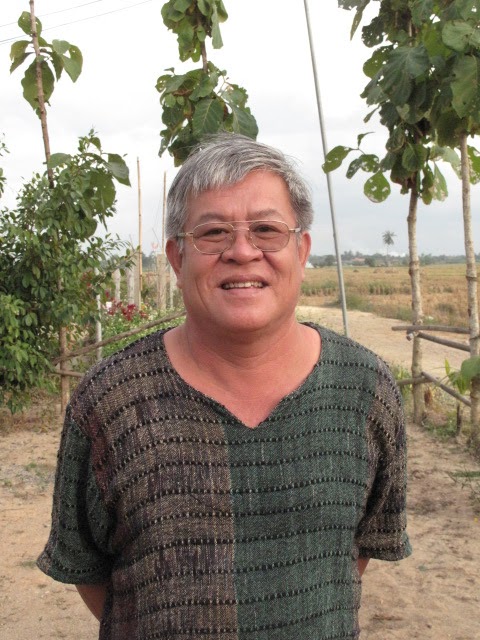
This is an Amazing Thailand travel blog (as a gateway to the greater Mekong region) with insider reviews of hotels in Bangkok, Pattaya, Koh Samui, Phuket, Chiang Mai and beyond. Tips on how to travel Thailand, and where to travel in the Thai kingdom. So use JING JING to plan your travel to Thailand -- ie flight to Bangkok -- find the best time to travel for festivals, Muay Thai, a local Thai Thai restaurant, and lots of fun stuff the Thais are famous for from Patong to Patpong to Phitsanuloke.
Thursday, 16 December 2010
The Hills are Alive with the Sound of ... Erhus
This is a photographer's dream ... the vivid textiles, the ornate costumes, the beautiful innocent faces. Snap! Snap! Snap Snap! "Over here, darling. Work it ... Work it!" I call out to the slightly reluctant uber-exotic models as my little Canon Ixus 200 Point-n-Shoot goes into overdrive.
"You should shoot the men; it's very rare to see them in full garb, especially with head-dress," counsels my friend, David, a veteran of this festival. Spoilsport!
What I'm gushing over is the Bua Tong (Mexican Sunflower) Festival, which has been staged in Hua Mae Kham each November for the past 21 years. The name becomes self-explanatory as you take the excellent new road all the way to the hill-tribe town nestled on the hills of the Thai-Burma border, a couple of hours northwest of Chiang Rai.
This really is the end of the line, geographically, for northern Thailand. But what a splendid view ... a carpet of yellow flowers, like daisies juiced up on, um, whatever it is that the Chinese ladies swimming team allegedly uses. As far as the eye can see.
In low gear, through army checkpoints and golden rice fields awaiting harvest, you arrive up at Ban Hua Mei Kham. Children ride oversized bicycles, and dogs rest in the shade of nipa huts. Chickens cross the road, just like in the joke.
There is no parking lot of course. Civilisation thankfully has not reached this far. But marshals do their best to shepherd people into suitable spaces among the bushes and houses. The swelling crowd is a mixture of outrageously costumed hill-tribes and locals. (The whole day I will only see around 6 farangs, most of them being the friends I came here with.)
With the Burma election recently completed, the Thai border patrols are on high vigilance with a flood of refugees expected. Major Saphun, a 13 year veteran of the military police, is on red alert, chatting up some Lisu girls on the verandah of a house, posing for photos with them and generally trying his luck. Sgt Niphun the same. "I come here to do security every year," the major tells me. I feel reassured.
What few soldiers are here, with M-16s slung over their backs, are all photographing the pretty village girls amid much laughter, as are a posse of high-ranking police officers all aglitter with medals and paratrooper wings.
If you sense that the atmosphere is folksy, you're absolutely spot on. The village cascades down the vertiginous hillside; some houses here, a store there. All overlooking a natural amphitheatre, which is where the festival is held.
As I scramble down the steep path, a pick-up stops alongside me. "Come," says the smiling major who’s pulled himself away from the village girls for a while. We hop into the back for the extremely short ride downhill.
Yellow, yellow, yellow. Sunflowers galore. Shortly, we pull up at the field, where makeshift bamboo benches have been installed among the flora as vantage points.
Some unseen guy blasts away on the Tannoy in Thai, no doubt telling us fascinating details about what we're seeing and about to see. There are troupes of Lisa, Akka, Hmong and many of the other half dozen or so hill-tribes who live in the surrounding mountains. Most used to toil on opium poppies, helping legendary local Khun Sa become the world's largest drug lord. But now, thanks to the Royal Projects, they grow other crops like rice, and have beautiful roads installed.
It feels like the cross-roads of China with all these ethnic minorities who originated in southern China, some with Tibetan and Mongolian origins. Raspy bamboo flutes and Erhus slice the cool air. The groups in turn parade and perform a song-and-dance routines. Some with a mint of coins in their hats. Others with shells on their costumes. Some with embroidered beads. All with brilliant colour.
One troupe grabs my eyes more than others -- a tangerine-clad group from a little Chinese village near Doi Mae Salong. They break into a routine that seems like a hybrid of Kylie Minogue's 'Do the Locomotion' and a traditional Fan Dance, jing jing.
The youngest performer on the day was a girl of about ten named Pepsi. (No truth in the rumour her brother is called 7-Up!)
As an example of the fascinating ethnicity of this area, they speak Yunnanese, "and only little bit Thai." At a rustic noodle shop up the hill (where we gorge on Yunnanese fishball noodles for only 20 baht), my Thai companion speaks Mandarin and some Yunnanese dialect to the Thai vendors.
The major walks past, chatting with some village girls. He smiles, winks and waves. Thailand’s national security is in good hands.
The sun begins to set on the marvellous valley. A chill comes into the air. I've got a full belly. And a full memory card in the camera. I just hope we've got a full tank of petrol to get us back to Thoed Thai.
Wednesday, 15 December 2010
Driving Licence Thailand: the REAL Road Rules --- finally available!
Thailand Driving License: The REAL Road Rules finally available thanks to WikiLeaks!
by Stu Lloyd www.thailandjingjing.blogspot.com
It is hoped that this definitive list will be soon be adopted as the official driving code of Thailand, in the absence of any other such known publication, so that all drivers on the road will act in strict accordance with it.
# 1. The Mercedes Benz always has right of way.
#2. The more wheels you have, the more right of way you have. (Except when Rule #1 applies.)
#3. Anything with two wheels or less does not count as a vehicle and should be disregarded completely. Even if it’s a 1800 cc Harley Davidson the size of the average Thai house.
#4. If you need to turn off, then turn off. If that means a right-angled swerve across three lanes on two wheels so you don’t miss your turn, please go ahead. We’ll just fit in with your plan. No need to indicate your intention.
#5. If in the process of executing that turn, you cause three motorcyclists and a tuk tuk to end up in the ditch, add 5 points.
#6. Indicators should only be used in the following fashion. If someone is behind you and wanting to overtake, put on your right indicator. This means either a/ it is clear and safe to overtake now or b/ don’t overtake now a bus is coming over the blind rise at a speed approaching 130km/h. It will soon become apparent which meaning was intended.
#7. Do have as many Buddhist amulets on the dashboard as possible. If you’re involved in a fatal accident, never mind -- there’s always another life, and another …
#8. Traffic jams can be frustrating, so, as soon as you get any open space at all, get your vehicle to its highest possible top speed. As a guideline the rpm counter should be kept in the red zone in event of any open road.
#9. When joining a busy main road from a small side soi, proceed directly into the intersection without stopping – or even pausing – for other traffic. This selfishly indulgent act of stopping and checking will only cause confusion for those behind you, with the possible result of them rear-ending you.
#10. When on a motorcycle, do not wear a helmet, and ride as fast as the bike will possibly go while using cars, buses, elephants, and chickens as slalom course markers. Irrespective of traffic conditions, possible dangers lurking around the corner, and pedestrians foolishly crossing the road at a marked pedestrian crossing, maintain this speed (once again, the red zone on your rpm gauge is a reliable indicator). After all, in the event of some other idiot doing the wrong thing, you want to be killed outright, not maimed.
#11. On the subject of pedestrian crossings, these are known to farangs as ‘zebra crossings’. There are no zebras in Thailand. Ignore. Proceed as usual.
#12. Do not wear a seat-belt. This will delay you when you stop at 7-11 to buy more beer for the drive, resulting in late arrival for the party. This is not acceptable to your thirsty friends.
#13. In the event you become completely, utterly, motherlessly drunk when drinking with your friends do not -- repeat: DO NOT! -- leave your vehicle there and attempt to walk home. In your drunken state you might be tempted to actually use a pedestrian crossing on foot, without observing the golden rule of crossing any road in Thailand: look Right, look Left, look Up then look Down before you cross. The buggers will get you from anywhere!
#14. Red lights. This is merely an optical illusion – all traffic lights in Thailand consist of three different shades of green. What you think is red is actually just dark green. Proceed as usual.
As a public service for farang motorists and tourists, this code will be made freely available in Hardship Posting volume 5. See www.stulloyd.com
Tuesday, 14 December 2010
Some steamy man-on-man action
| Mor Ta, master torturer |
Crudely hand-painted signs in Thai lead us increasingly further from the outskirts of Chiang Mai to rustic villages where, just as the houses run out and the rice fields begin, we arrive at what can best be described as a shack.
Ta and his assistant amble out to greet us, more inquisitively than welcomingly. A couple of mutts try and bark us away. Ta is a plump, square headed-chap with thick-lensed glasses, a Thai Yai (ethnic minority) doctor who studied in Burma, and has practiced massage for 30 years. He treats many of the battered and bruised Muay Thai boxers in Chiang Mai. And proudly tells us about one Danish customer who came to him unable to walk. After four months of treatments, he was walking all over this neighbourhood.
Ta has lived in this place for five years amid banana trees, bamboo groves, and rice fields which are currently undergoing the end of season burnoff.
Pleasantries out of the way, we are told that as this is our first visit we must offer 39 baht as an gift to Buddha to ask us to make the pain go away. Oh, does this mean we don't need the actual message then?
Ta sizes me up, presses my bicep and says: 'Soft. Farangs eat bread when they are young, not like Thais who eat rice.' He should talk, pudgy little guy that he is; raised on cupcakes by the look of it. He then over-estimates my age by 4 years. Well I never!
He pulls out some oversized canary yellow football shorts, sharading that I need to strip off everything and change into these. (There are no change rooms after all, just an open-sided shed where his steam rooms are.) I feel decidedly uncomfortable when he holds the towel around me so I can change.
We're then ordered into the steam room, a primitive affair with a green drape over the front trapping the camphor-smelling steam in. Cough, choke, splutter, wheeze. This is more like an interrogation chamber. We sit in pitch darkness on the low bench in the box which is no more than 2 metres x 2 metres.
'Come out when you're hot,' is the instruction from Mor to his assistant to my companion to me, a lengthy but necessary chain of command given he speaks some weird dialect which is then translated into Thai then into English.
We soon burst from the room sweating and gasping. We're seated and given a cup of reddish liquid from a thermos. 'Yaa dong?' I jokingly ask, referring to the illicit Thai alchohol popular in the north. No, it's just herbal tea which tastes of sandalwood. Or maybe just sandals, jing jing. It's rank.
We're ordered back into the steam room for a second round of interrogation. Cough, splutter, choke. Ok, Ok, I'll talk. I'll give you all the state secrets you want ... just let me out.
We're taken to the adjoining shed, another open-sided breeze-block-asbestos roofed affair. A few thin mattresses adorn the floor. Forget the usual chimes and piped new-age music ... a 14" TV blasts out some American war movie. Mor Ta kindly tilts the set so I can see it more clearly.
Then he goes to work ...
… with his nail-clippers.
Seriously! He hoists my toes up and starts clipping my toe-nails, which were admittedly overdue for a trim. That out of the way, he starts roughly jabbing his thumbs into my lower calf. Aaaaargh! Oh God stop! Sheeeeeeeeeeeeeeeeeitttt! He calmly pronounces my kidneys to be in very good order.
And so it went for ... actually I don't know how long. You see, he doesn't work to a set time frame. He works on you till all your ailments are fixed. (Or, I suspect, you have a full set of new ailments inflicted by him.) He jabs and pokes and prods and rubs, flopping me around like a rag doll. A little bit of oil on the knees then ,,, Aaaaaaaaaaaaaaargghohmygodstopthatyou'regonnakillme!!!
He declares my knees to be not very good.
No shit Sherlock, what was your first clue?
Then he declares my heart and liver to be healthy, but too much stress in the intestine. Less coffee and relax more I'm told. Am I stressed? Well I was doing perfectly fine until I arrived here, thank you.
Around two hours later, the carnage and humiliation suddenly ceases. 'Steam.'
I hobble into solitary confinement in the steam room again. Everywhere hurts. I emerge for some fresh air, checking that the coast is clear lest I get summoned for another session with the master torturer. Luckily he's nowhere to be seen and I savour this time the taste of sandals in the tea.
Omo, a pin-cushion-sized pug-like thing which may be a dog, has a little yap at me. Shhh! Shhh! He's going to ruin my escape plan. I see the assistant coming so duck for cover into the steam room again. Cough, choke, splutter, wheeze.
When I emerge I come face to face with Doctor Pain. But this time he's beaming. 'Yaa dong?' he says conspiratorially. He motions with a cupped hand for me to follow him down the back of the shed. There he reveals a glass jar full of congealed red liquid. He lifts the lid and the pungent musky odour nearly exfoliates my skin. He ladles out a little portion. More? he asks rhetorically before tipping the rest of the ladle out. He adds some honey.
"Good for calm nerve and .... PING!" he says excitedly, graphically pointing to his groin with a sudden erect finger. "Haha, yes, ..." He holds a finger to his mouth -- the secret of his mystery potion must not be leaked to the womenfolk lurking just out of earshot.
I sip it. Whisky, albeit it not fine 12 year old single malt Scotch, has obviously played a large part in its creation. But it's red and earthy. I feel my heart either skip a beat or beat twice, the details are not clear. A feeling of extreme well-being washes over me.
We pay, 500 baht ($18) each for the approximately 2-hour session, hop into the car and promptly get lost trying to retrace our steps. Damn, that yaa dong is strong stuff.
I can undoubtedly say it was the best massage I've ever had. It was the real thing, and one of the most authentic experiences I've ever had. But not the most enjoyable. But if I have a serious ache or pain I know where to go. For more.
Monday, 13 December 2010
Six of the best from Chiva Som
It seems like an eternity since Chiva Som -- 'the haven of life' -- ushered in a whole new level of wellbeing to the world from its quiet little corner of Hua Hin.
In fact it's been 16 years, and none of the youthful passion has worn off. Witness the fact that this year alone the pioneering spa has won no less than six, yes SIX, major accolades:
1. 'Top Ten Best Medical Programs' SpaFinder Readers' Choice Crystal Award 2010
2. 'Best Destination Spa' The Crystal Awards 2010
3. '4th Favourite Destination Spa' Conde Nast Traveller Readers' Spa Awards 2010
4. 'Best Amenities/Products' Conde Nast Traveller 2010 Readers' Travel Awards
5. 'Top 5 Destination Spa' Conde Nast Traveller 2010 Readers' Travel Awards
6. 'Best Overseas Spa Resort' Luxury Travel & Style Magazine 2010 Gold List
In the humble and gracious words of Krip Rojanastien, CEO & Chairman of Chiva-Som:
"Chiva-Som has acquired a reputation in helping people all over the world to achieve lasting wellness in mind, body and spirit. In doing so, we have leveraged a quality in the Thai people, that of Thai hospitality. Thai hospitality promotes the genuine care for the wellbeing of our guests and this has distinguished Chiva-Som in the world of wellness and sets us apart in terms of service delivery. It is the staff of Chiva-Som who truly deserves the credit for this important recognition."
2. 'Best Destination Spa' The Crystal Awards 2010
3. '4th Favourite Destination Spa' Conde Nast Traveller Readers' Spa Awards 2010
4. 'Best Amenities/Products' Conde Nast Traveller 2010 Readers' Travel Awards
5. 'Top 5 Destination Spa' Conde Nast Traveller 2010 Readers' Travel Awards
6. 'Best Overseas Spa Resort' Luxury Travel & Style Magazine 2010 Gold List
In the humble and gracious words of Krip Rojanastien, CEO & Chairman of Chiva-Som:
"Chiva-Som has acquired a reputation in helping people all over the world to achieve lasting wellness in mind, body and spirit. In doing so, we have leveraged a quality in the Thai people, that of Thai hospitality. Thai hospitality promotes the genuine care for the wellbeing of our guests and this has distinguished Chiva-Som in the world of wellness and sets us apart in terms of service delivery. It is the staff of Chiva-Som who truly deserves the credit for this important recognition."
If that doesn't rub and tug at your heartstrings, I don't know what would, jing jing.
Saturday, 11 December 2010
Still on the hippy trail in Samui
As we drive up through the backblocks of Lamai into the Varinda Resort I do a double-take. It seems like Alice in Wonderland has dropped an acid trip. Or Andy Warhol and Salvador Dali have just been here on a huge beach-side bender.
Mermaids and goats poke from the undergrowth. Bicycles hang from trees. Multi-hued rocking horses eye me from the pathway, jing jing.
Everything --and I do really mean everything -- is in bright, bold, primary colours. In your face.
In the lobby I do another double-take. Literally. Owner Yindee (Noi) and her daughter Varinda (Oil) could almost pass for twins although there is 20 years between them. Oh, and they're not mother-daughter; Noi is the aunt, being Oil's mum Chanida's sister. Goddit?
In their tie-dyed tees, sarongs, and wildly coloured bandannas, you immediately realise this is not the Hyatt Regency. "You don't come to a hotel in Samui, you are coming to see Noi your friend," she beams. "It is very humble but this is our house and your home too."
Noi sees herself as a hippie and dresses like this everyday ... even when on corporate roadshows. A far cry one suspects from when she worked with UNESCO for 14 years. "Samui talks about 4 star, 5 star, but we are here for the backpackers. Twenty years ago, this was the place for Aussie hippies to party."
And a nice spot it is too, on a promontory affording long views over Lamai Bay. "We are not on the beach but we have access through the family's property next door."
Family is a recurring theme with the artistic Noi. She's a painter, and so's Oil, hence the colourful splashes on every surface in, on and around the main buildings and the villas." The latter studied in the UK, and Chanida''s son is about to study hotel management in Switzerland. "But I told him you will not change anything here, we like it like this."
There is lots to love about the low-key laid-back environment. All the balcony railings and all the furniture in the restaurant, are all hand made from wood from the property's orchard. It is rustic and enchanting compared to many of its newer modern generic neighbours. And when you're in the poolside sala overlooking the bay, nirvana seems somewhere just over the horizon.
"Samui is great because there's no low season," she says with those eyes sparkling again, laughing. "Great isn't it? Amazing!" Just then the rain slices in over the bay, sending diners ducking for cover.
"You can go to Bali and the beaches are great, too, but in Thailand ... it's the people," she says, touching her heart. "Next time come, and we'll go crazy, have a BBQ ..."
They don't teach you that at hotel management school in Switzerland. But they should.
Mermaids and goats poke from the undergrowth. Bicycles hang from trees. Multi-hued rocking horses eye me from the pathway, jing jing.
Everything --and I do really mean everything -- is in bright, bold, primary colours. In your face.
In the lobby I do another double-take. Literally. Owner Yindee (Noi) and her daughter Varinda (Oil) could almost pass for twins although there is 20 years between them. Oh, and they're not mother-daughter; Noi is the aunt, being Oil's mum Chanida's sister. Goddit?
In their tie-dyed tees, sarongs, and wildly coloured bandannas, you immediately realise this is not the Hyatt Regency. "You don't come to a hotel in Samui, you are coming to see Noi your friend," she beams. "It is very humble but this is our house and your home too."
Noi sees herself as a hippie and dresses like this everyday ... even when on corporate roadshows. A far cry one suspects from when she worked with UNESCO for 14 years. "Samui talks about 4 star, 5 star, but we are here for the backpackers. Twenty years ago, this was the place for Aussie hippies to party."
And a nice spot it is too, on a promontory affording long views over Lamai Bay. "We are not on the beach but we have access through the family's property next door."
Family is a recurring theme with the artistic Noi. She's a painter, and so's Oil, hence the colourful splashes on every surface in, on and around the main buildings and the villas." The latter studied in the UK, and Chanida''s son is about to study hotel management in Switzerland. "But I told him you will not change anything here, we like it like this."
There is lots to love about the low-key laid-back environment. All the balcony railings and all the furniture in the restaurant, are all hand made from wood from the property's orchard. It is rustic and enchanting compared to many of its newer modern generic neighbours. And when you're in the poolside sala overlooking the bay, nirvana seems somewhere just over the horizon.
"Samui is great because there's no low season," she says with those eyes sparkling again, laughing. "Great isn't it? Amazing!" Just then the rain slices in over the bay, sending diners ducking for cover.
"You can go to Bali and the beaches are great, too, but in Thailand ... it's the people," she says, touching her heart. "Next time come, and we'll go crazy, have a BBQ ..."
They don't teach you that at hotel management school in Switzerland. But they should.
Tuesday, 7 December 2010
Amari Residences Bangkok -- well, well, well ...
When I first heard the address of this new Amari Residences Bangkok property, I was struggling to place it. It seemed to be well away from the usual well-worn hotel strips, and I wondered why. Was the owner feeling OK when he commissioned this property?
The answer is 'very well' thanks ...
This came clear to me as our taxi rounded the corner at Bangkok Hospital on New Petchaburi Road. Health and wellness and medical tourism is one of the real boom categories for travel to Thailand these days. And just 500 metres from one of the city's biggest and best hospitals is the new Amari Residences.
(In the same area are massive companies such as Electrolux, Yokohama, Siemens, and Italian-Thai, so it's a good location for business travellers, too.)
So into the brand new lobby we go, all clean lines and Martha Stewart furniture. "That one coffee table alone cost us 200,000 baht," says Front Office Manager, Suwat. Off to one side of the lobby is a library, where some folks sit and read the morning papers. To the other side is a new cafe concept called Buttercup, from where tantalising smells of freshly-baked pastries from its European-style kitchen waft into the lobby.
But it's the courtyard that really radiates a sense of well-being. The big open area is dominated by a thong kwao tree, famous for its sap which is a pain reliever. Nice concept! Especially as the breakfast area and restaurant overlook this.
The rooftop is also an inspiring area, where more will doubtless be done once the hotel gets through the soft-launch period. But for now there's a large lap pool (built for functional swimming of laps, with lanes marked and everything, and alarmingly not a cocktail pool bar in sight!) A fitness centre on the roof, and ex-nurses working as therapists in the spa also speaks to the wellbeing orientation of the residences.
And so upstairs to rest and recuperate ...
Our one-bedroom suite was a full 60 sq metres -- that's the equivalent of a junior suite in many other hotels I've stayed at. Room rates kick off around 2000 baht per night, and long term guests can expect to pay around 55,000 baht per month.
The warm colours certainly work hard instil a sense of upbeat into this place. Egg yolk orange seems to be the central colour theme, jing jing.
This is complemented by quirky panels of contemporary colours giving it a spacious and airy feeling overall. All this ties nicely into the Amari's 'Colours & Rhythmns' rebranding vibe.
Not that I was there for medical reasons (honestly, my facial skin has always been this tight!) but I certainly came away with a good feeling. OK, maybe I had my boobs lifted, a little, but that's all I'm owning up to ...
The answer is 'very well' thanks ...
This came clear to me as our taxi rounded the corner at Bangkok Hospital on New Petchaburi Road. Health and wellness and medical tourism is one of the real boom categories for travel to Thailand these days. And just 500 metres from one of the city's biggest and best hospitals is the new Amari Residences.
(In the same area are massive companies such as Electrolux, Yokohama, Siemens, and Italian-Thai, so it's a good location for business travellers, too.)
So into the brand new lobby we go, all clean lines and Martha Stewart furniture. "That one coffee table alone cost us 200,000 baht," says Front Office Manager, Suwat. Off to one side of the lobby is a library, where some folks sit and read the morning papers. To the other side is a new cafe concept called Buttercup, from where tantalising smells of freshly-baked pastries from its European-style kitchen waft into the lobby.
But it's the courtyard that really radiates a sense of well-being. The big open area is dominated by a thong kwao tree, famous for its sap which is a pain reliever. Nice concept! Especially as the breakfast area and restaurant overlook this.
The rooftop is also an inspiring area, where more will doubtless be done once the hotel gets through the soft-launch period. But for now there's a large lap pool (built for functional swimming of laps, with lanes marked and everything, and alarmingly not a cocktail pool bar in sight!) A fitness centre on the roof, and ex-nurses working as therapists in the spa also speaks to the wellbeing orientation of the residences.
And so upstairs to rest and recuperate ...
Our one-bedroom suite was a full 60 sq metres -- that's the equivalent of a junior suite in many other hotels I've stayed at. Room rates kick off around 2000 baht per night, and long term guests can expect to pay around 55,000 baht per month.
The warm colours certainly work hard instil a sense of upbeat into this place. Egg yolk orange seems to be the central colour theme, jing jing.
This is complemented by quirky panels of contemporary colours giving it a spacious and airy feeling overall. All this ties nicely into the Amari's 'Colours & Rhythmns' rebranding vibe.
Not that I was there for medical reasons (honestly, my facial skin has always been this tight!) but I certainly came away with a good feeling. OK, maybe I had my boobs lifted, a little, but that's all I'm owning up to ...
Saturday, 4 December 2010
Lounging round in Samui ...
If the greeting at the Business Class/ VIP lounge at Samui's cute little airport is not as warm as you might rightly expect, there's a good reason.
You see, the poor attendant there spends roughly three quarters of her time throwing freeloaders out of the lounge. No, not travel writers, I mean real free-loaders: punters hoping to scam a free meal or free internet or nice comfy sofa away from the madding crowds.
It's not that it's not clearly signposted as the VIP lounge. Yet backpackers who clearly have not showered or shaved in months nor spent more than 25 baht a night on accommodation walk up to the sliding doors with a look of entitlement in their eyes and a feeling of nourishment already in their bellies.
An array of bain-maries holds curry puffs and sticky rice among other delicacies.
'Mmmm, this looks great,' says an American next to me, piling his plate till it nearly interfered with the chandelier. Just then, the harried attendant returns to the lounge and asks him for his boarding pass. Economy class! See ya ...
Another unwashed couple walk up to the doors. with a quizzical look on their faces. Clearly they know they don't warrant entry Asia's Boutique Airline's lounge, but they try anyway. "Boarding pass please." See ya ...
And so it went. Time after time. The lounge attendant rolls her eyes. See ya ...
A ratio of 4 wannabes for every genuine Business Class passenger, jing jing!
With every eviction my sense of smugness reached cruising altitude. I tucked into yet another bowl of special-order shrimp wonton soup. And another. This is great soup. Order a bowl. Order two bowls. It's worth the price of flying Business Class on Bangkok Airways alone.
But one thing that is available to all passengers at Samui airport, including the great unwashed, is the toilet block with its built-into-the-wall fish tank. Skittering tropical fish and the odd big janitor fish. A bit disconcerting to have that big sucker -- pun fully intended -- staring down at you at close quarters as you're trying to empty your bladder.
Footnote: Stu Lloyd travelled to Samui with the assistance of Bangkok Airways.
(Photo above is of lounge at Bangkok airport, not Samui.)
You see, the poor attendant there spends roughly three quarters of her time throwing freeloaders out of the lounge. No, not travel writers, I mean real free-loaders: punters hoping to scam a free meal or free internet or nice comfy sofa away from the madding crowds.
It's not that it's not clearly signposted as the VIP lounge. Yet backpackers who clearly have not showered or shaved in months nor spent more than 25 baht a night on accommodation walk up to the sliding doors with a look of entitlement in their eyes and a feeling of nourishment already in their bellies.
An array of bain-maries holds curry puffs and sticky rice among other delicacies.
'Mmmm, this looks great,' says an American next to me, piling his plate till it nearly interfered with the chandelier. Just then, the harried attendant returns to the lounge and asks him for his boarding pass. Economy class! See ya ...
Another unwashed couple walk up to the doors. with a quizzical look on their faces. Clearly they know they don't warrant entry Asia's Boutique Airline's lounge, but they try anyway. "Boarding pass please." See ya ...
And so it went. Time after time. The lounge attendant rolls her eyes. See ya ...
A ratio of 4 wannabes for every genuine Business Class passenger, jing jing!
With every eviction my sense of smugness reached cruising altitude. I tucked into yet another bowl of special-order shrimp wonton soup. And another. This is great soup. Order a bowl. Order two bowls. It's worth the price of flying Business Class on Bangkok Airways alone.
But one thing that is available to all passengers at Samui airport, including the great unwashed, is the toilet block with its built-into-the-wall fish tank. Skittering tropical fish and the odd big janitor fish. A bit disconcerting to have that big sucker -- pun fully intended -- staring down at you at close quarters as you're trying to empty your bladder.
Footnote: Stu Lloyd travelled to Samui with the assistance of Bangkok Airways.
(Photo above is of lounge at Bangkok airport, not Samui.)
Wednesday, 1 December 2010
What's coming up in December ...
Wow, December already ... and I can already feel the streets are busier around Bangkok and Chiang Mai at the moment, and my flight the other day was standing-room only! It can only mean one thing: the high season.
So what stories are in store for Jing Jing readers this month?
* We're moving on from Samui to the north ... Doi Mae Salong, a very charming Chinese town on the Thai-Burmese border. We'll be off-road motorbiking, as well as eating beautiful French pastries in one of the coolest cafes I know, and checking out fascinating stories of Chinese war generals and renowned drug lord, Khun Sa.
* Therd Thai and Doi Hua Mae Kum annual Bua Tong festival, where dozens of different hilltribes gather for song and dance amid the blooming sunflowers.
* The Loy Krathong Light and Sound Show spectacle at Sukhothai ... wait till you see my pics from that.
* And the Yee Peng Khum Loy festival in San Sai, Chiang Mai, in which thousands of glowing lanterns are released. One of the most amazing things I've seen -- and felt -- in my life, jing jing!
So, enjoy December and look out for those stories.
Cheers, Stu.
PS: Please forward this to anyone who might enjoy the Thailand Jing Jing blog, and get them to sign up to follow it at www.thailandjingjing.blogspot.com or else on my new Facebook page Stu Lloyd / Worldsmith 360 where you'll find a lot more stuff about Thailand and my travel adventures.
So what stories are in store for Jing Jing readers this month?
* We're moving on from Samui to the north ... Doi Mae Salong, a very charming Chinese town on the Thai-Burmese border. We'll be off-road motorbiking, as well as eating beautiful French pastries in one of the coolest cafes I know, and checking out fascinating stories of Chinese war generals and renowned drug lord, Khun Sa.
* Therd Thai and Doi Hua Mae Kum annual Bua Tong festival, where dozens of different hilltribes gather for song and dance amid the blooming sunflowers.
* The Loy Krathong Light and Sound Show spectacle at Sukhothai ... wait till you see my pics from that.
* And the Yee Peng Khum Loy festival in San Sai, Chiang Mai, in which thousands of glowing lanterns are released. One of the most amazing things I've seen -- and felt -- in my life, jing jing!
So, enjoy December and look out for those stories.
Cheers, Stu.
PS: Please forward this to anyone who might enjoy the Thailand Jing Jing blog, and get them to sign up to follow it at www.thailandjingjing.blogspot.com or else on my new Facebook page Stu Lloyd / Worldsmith 360 where you'll find a lot more stuff about Thailand and my travel adventures.
Subscribe to:
Posts (Atom)