Showing posts with label chiang rai. Show all posts

Monday, 11 February 2013

One of the best places to honeymoon? Kuoni says Thailand.

Banyan Tree Koh Samui - a perfect honeymoon hideaway
 The word honeymoon itself is enough to bring sighs and gushes to the lips of young maidens, and fleeting clouds of twinkling stars to their eyes. The stuff of fairy tales since they were little princesses ...

So no pressure then when it comes to choosing the best honeymoon destination.

Especially if it's only a once-in-a-lifetime experience (which we all sincerely hope it is when going into it.)

Let's narrow it down for you. The good folks at Kuoni have just released their 2013 Travel Trends report and Amazing Thailand ranks number 3 in terms of the most desirable and best places to go for a honeymoon this year.

A couple I know were both working in a resort in the Maldives when they got married. So, if you already live and work in the Maldives -- another shitty day in Paradise! -- where do you go for your honeymoon?
In their case, Bangkok. Jing Jing!

Andrew wanted to play golf with his mates, and Liz was happy to trawl the shopping emporiums of the City of Angels.

Personally I might look further afield to some of the smaller islands. Ko Samui comes immediately to mind. (For your info, the word koh in Thai means island, so need need to repeat Koh Samui island.) I have blogged about Samui a fair bit, so have a little search around my blog archive.

Beautiful sunsets and romantic beach walks
Then there's Yao Noi, a really unspoilt little island in the Krabi area (so you could combine a few spots, some lively, some quieter and more secluded in your trip). If you really want to indulge in the most wonderful spot, choose the Six Senses Yao Noi. 

Ko Lanta is another that comes to mind in the Krabi area, in the Andaman Sea, with endless stretches of white sandy beaches. As does Khao Lak, just north of Phuket.

All those places will give you idyllic beaches, sunshine, diving and snorkelling. 

Do I actually recommend Phuket? Frankly I am over it as I've been travelling there since 1988 (!) and I can see how it's really popular with the beach and beer crowd -- not really how you want to spend your honeymoon is it? (Or if so, good thing you are not married to me!) Although there is the Millionaire's Mile of Anantara, Indigo Pearl, JW Marriot, etc up the very top north west of the island.

But if you prefer mountains and quieter bucolic times, choose Chiang Mai or Chiang Rai which also have a lifetime's worth of cozy and secluded resorts, with languid vistas of rice fields and beautiful valleys.

Gardens at Doi Tung, Chiang Rai province.
So that's almost a top 10 destinations for honeymoon in Thailand. Hope it's been a useful starting point for you? Let me know.

Of course, if you'd like to go to the Maldives for honeymoon anyway, it's easy to access from Bangkok too. So you can have the best of both worlds, and, like Liz and Andrew, claim you spent your honeymoon in Bangkok.


Friday, 8 July 2011

Lanna 101: new magazine about Northern Thailand (Chiang Mai, Chiang Rai, Pai, etc)

If you travel to Thailand or Bangkok, you will probably already know about Bangkok 101 magazine, which is the best-selling lifestyle, travel and 'what's on' type magazine about the great many goings on in that city.

Now comes Lanna 101: your definitive guide to northern Thailand.

It covers the region from Sukhothai north (one of the dramatic ancient capitals, roughly 350km northwards of Bangkok is considered northern Thailand).  So Chiang Mai, Chiang Rai (which turns 750 next year), Pai (Thai tourists' favourite winter retreat), Mae Hong Son (interesting border city), the intriguing The Golden Triangle (where Laos and Burma meet Thailand on the Mekong River),  Loei (near Isaan and the Mekong), and one of my personal favourite cities Nan (an up and coming Pai, full of coffee shops, hanging flower baskets, and a well-preserved Lanna culture).

So what is Lanna? Essentially it was the Kingdom of One Million Rice Fields which spread from what is now eastern Burma down through this region in the 12-18th centuries under the guidance of founder King Mengrai ... well, he wasn't around for all of those 500 years, of course, but you understand what I mean.

The first issue of the magazine is on sale at the news stands NOW, but you can also jump online at www.lanna101.com to see the best of travel, accommodation, arts, community, wellness, nightlife, etc, etc, etc.

It's bloody brilliant. I know, because I edited it, jing jing.


Wednesday, 1 June 2011

Thai elephants, elephant shows and elephant camps in Thailand

Amazing Thailand in synonymous with elephants. So when you travel to Thailand make sure to catch one of the many excellent elephant shows around the country.

An elephant whispers sweet muddy things in my ear ...
Asian elephants are different to African elephants in that they are far more obedient and can be trained, hence their endearing ability to pick up the amazing skills with which they thrill and delight audiences. And anyone who has ever watched Dumbo loves baby elephants, too, right?

Many of these camps also offer elephant trekking (a 5 minute tootle around the track or for several hours), mahout courses (in which you can learn to ride and control an elephant, learn mounting and dismounting techniques, key commands (they have four main gears - front, back, left and right), and even how to take an elephant's temperature.) The latter involves rubber gloves.

So here is a list of the best shows, camps and trekking with Thai elephants: 


Chiang Rai: 
Anantara Golden Triangle Hotel
Four Seasons Tented Camp

Chiang Mai:
Mae Sa elephant camp
Mae Taeng elephant camp
Chiang Dao

Lampang:
Thai Elephant Conservation Centre

Phuket:
Siam Safari

Koh Samui:
Namuang Safari Park

Pattaya:
Elephant Village Pattaya

Ayutthaya (only one hour from Bangkok):
Royal Elephant Kraal and Village

This list is just a start. Especially in northern Thailand, there are dozens of smaller ones doing great work in conservation. Please let me know and I can update this list.

You might want to check TripAdvisor for the most popular rated show in the area you're going to.

Oh, one final thing. It's easier to remember the Thai word for elephant: Chang. That's because these animals are named after Thailand's most famous beer, jing jing.


Question: where was the most fun Thai elephant show you've been to?


Friday, 1 April 2011

Northern Thailand blanketed in snow ...

Road inside Chiang Mai University campus
I was greeted by an amazing sight in Chiang Mai this morning ... snow!!!

I couldn't believe my eyes. Snow at this time of year -- April. Hold on, I thought. I'm now back in Thailand. It should be around 40 degrees celsius at this time leading up to the Songkhran festival, where the nation douses each other in water to cool off and have a few laughs in the name of New Year.

As far as the eye can see, Chiang Mai has been transformed into a Christmas card scene. Doi Suthep -- a wonderful wall of white with the golden temple on top.

All the neighbours' kids are out screaming and running around with excitement, and I can see young James next door starting on a snow man with his maid down the bottom of the garden.

A quick check with some friends as far afield as Chiang Rai, Pai and Mae Hong Son reveals they too are enjoying this freak occurrence, which is apparently brought to us by a low pressure system over China. So much for global warming.

It has snowed only once in Thailand before, in Chiang Rai in the 1950s, jing jing.

So this is so cool, literally. None of us who've seen this amazing vista of Chiang Mai carpeted in snow will ever forget this day.


Friday, 28 January 2011

Slighty potty ...

Remember the movie Ghost? Control yourself.
Doi Din Daeng. I love the onamatopeic alliteration of the name and love saying it. Doi Din Daeng, Doi Din Daeng, Doi Din Daeng.

It actually means Red Clay Hill, and is a rather suitable name for this very artful pottery, located in the bucolic rice fields north of Chiang Rai city.(Except, there's no hill and, I'm led to believe, that they 'import' their clay from Chiang Mai.)

It's owned by a charming Thai-Japanese couple, with the super-artistic Somluk Pantiboon -- who was behind the first Bamboo Pagoda I blogged recently -- being the head ceramist.

They sell their product right there on the premises -- we picked up some great coffee mugs -- or you can order wholesale; many major hotels and restaurants number among their clientele for vases, dinner sets, bowls, wash basins, etc. (The Legend in Chiang Rai, for instance, got all its ceramics fittings from here, and I noticed an order for a well-known spa in Hua Hin being made, too.)

Somluk vents his frustration by chucking stuff at the walls.
They should put a bigger sign on the highway for people to find this place. A tiny little pottery piece is basically it, and  -- as suitably arty-farty as it is -- as you whiz by Highway 1 at 150km/h, dodging chickens and water buffalo, you're hardly going to notice it.

Even if pottery's not your thing, they also boast one of the coolest cafes in all of northern Thailand. A lovely setting among the old teakwood buildings, with scrumptious cakes and coffees. Worth coming here just for that.

But sadly, and surprisingly, no, um, glazed donuts. (Sorry, that was the only pottery pun I could think of ...)

Where is it? 49 Moo 6, Tambon Nanglae, Chiang Rai, 053-705-291. Going north on Highway 1 from Chiang Rai, it's about 15km south of Mae Chan on your right (there's a U-turn bay there after the big coffee shop on your right).


Wednesday, 26 January 2011

The real legend of Chiang Rai ...


The Legend is a wonderful touch of Lanna magic right on the often-misty banks of the Kok River, adding a touch of adventure and mystery to your northern adventures. 

Any closer to the water, and it would be a floating hotel.

Starting the day with their hearty breakfast buffet against this backdrop harks back to an earlier era of pioneers' machetes hacking through the jungles of IndoChina. But ...

Thankfully The Legend is firmly planted in the 21st century. Its style is comfortably local, affording you excellent service but without the stuffiness that some bigger international hotels insist on. 

The top villas offer spa pools set in the privacy of their own lush garden, and bathrooms large enough to wash a herd of water buffalo in, jing jing.

Fountains and plenty of local wood make you feel comfortably at home in Lanna, but if you need to take things down a further notch, try their spa by the river with its soothing sounds of water and nature. That in itself is also a bit of a Lost World experience ...

Ok, Ok, maybe there's something in the drinking water here -- I told you it was close to the river!

124/15 Kohloy Rd, Robviang, Chiang Rai, 053-910-400; www.thelegend-chiangrai.com

Le Meridien in Le Chiang Rai


The sparkling diamond among Chiang Rai’s new glory box of hotels, Le Meridien is best positioned as a base of creature comforts from which to explore the wilderness of Chiang Rai. 

Actually the architects have done a fine job of creating its own wilderness, with the buildings set around a sculpted lake near the Kok River, and glorious old trees expressing themselves from between the various wings.

The rooms feel more like luxury apartments in Sydney, London, or New York, with a nouveau and chic design appeal. Muted greys and browns are slick yet homely, contrasting strongly against the greenery which imposes itself through the windows.

All of this contemporary design is integrated with local touches. Witness the lobby with a fleet of what look like alien spacecraft zooming across its wall, but actually are the lids of cooking pots or somesuch. Or the landscaping from the lobby which apparently allows one to imagine Budhha's eyebrows. Jing jing! (Perhaps after a few red wines at Chill Bar.)

The latest in technology is employed, such as the Global Adapter which allows you to charge MP3 players, your mobile phone, PDA, travel speakers, etc. Practical stuff, well done, Le Meridien!

While you can cocoon yourself in its luxury water-bound seclusion, including its top-rated Parvati spa and fine F&B offerings (great Italian at Favola, anyone?), it’s also in the same street as the lively Leelavadee Bar and a number of local eateries if you want to reach out and immerse yourself into the local life.

Le Meridien Chiang Rai is, as they say in the classics, ze duck's nuts.

221 / 2 Moo 20 Kwaewai Road, Robwieng, Chiang Rai, 053-603-333; www.starwoodhotels.com/lemeridien

Tuesday, 25 January 2011

Northern Thailand - Nirvana on two wheels


Your humble scribe with friends at the Golden Triangle.
When it comes to motorcycling, the northern Thailand's Lanna region really is heaven – or nirvana – on two wheels. Surprisingly excellent roads (the drivers, well, that’s a separate issue), stunning mountain and valley vistas, cheap petrol with smiling pump-attendants, plentiful accommodation in the 300-1000 baht a night range, tasty food on every corner, and we haven’t even got to the best bit yet …
In what other country can you have a hard day in the saddle and then stop in just about any small town and get a great massage for your weary bum that’ll cost you around 150-200 baht per hour? That's $5 or $6 to you.

It doesn’t matter what two wheels you get around on frankly. 100cc Honda Ladyboys or 1800cc Harleys are all the same to me (although I choose to ride a BMW F650GS) … just a way of getting out there and seeing what too few other visitors to the region are seeing. Away from the well-worn tour bus circuit. Most rental shops (see box) cater well in the 200-650cc range, bikes that are big enough to deal with the vertiginous challenges of some of the mountainous terrain and give you a comfortable enough ride along the way.

On the road to Doi Ankhang.
Before you head off, two words: GT Rider (www.gt-rider.com). This website is an amazing resource where keen riders (many of them passionate motorcycling residents of the north) write up ride reports, recommend hotels and eateries to stay or avoid, and generally clue you in to what’s hot and what’s not in Lanna. 

GT Rider was set up by Aussie David Unkovich who lives in Chiang Mai and has covered possibly one million kilometers on these roads over the last 30 years. Jing jing!

He also publishes the best maps outlining classic trips such as the Mae Sa Valley / Samoeng loop, the Mae Hong Son loop, the Golden Triangle, and so on. (GT Rider maps are available from many bookstores in Lanna and on GPS too.)

You can string these together to make your own customized itinerary. And, of course, there’s all the bits in between that make it really interesting … it may be a quaint hill-tribe village a few kilometers off the track, it might be a great coffee spot lookout (like 7km south of Mae Hong Son, where the guy has the kettle boiling on the log fire!). Well, you get the idea.

Rice padi in the Kok River valley.
As for my personal favourites, there’s the 1148 which links Chiang Kham to Nan, an endless windy road, perfectly cambered with gorgeous valleys (keep your eye on the road, though). Chiang Mai to Pai’s 482 curves. Highway 12 from Phitsanulok west to Lom Sak with picture-postcard valley views, flower gardens and coffee shops aplenty. All the arrow-straight highways between Uttaradit and Sukhothai where you can really put your machine through its paces … 

Which brings us to speed limits. I did see a police car. Once. Somewhere near Lamphun. Entering a town, signs read: ‘City Limit – Reduce Speed.’ It doesn’t say down to what.Mostly it’s up to the rider to ride according to the conditions within his or her own ability. Sometimes a brilliant road will suddenly become a 10m stretch of gravel, with no warning sign (at least not in English).  And then,  there’s other things you will routinely encounter on roads along the way: Stray dogs. Chickens. Water buffalo. Elephants. 

But the biggest hazard is other motorists and, on a serious note, the fatality rates in Thailand are extremely high; unlicensed drivers and riders, drunk driving, buses overtaking cars which are overtaking trucks who are passing a scooter on a blind rise round a sharp mountain corner on a single-laned road.

Which is probably why many opt for off-road riding as a better alternative.

 One of the most endearing things – and this says a lot about amazing northern Thailand and its people – is the amount of times I’ve had my bike fixed for free. Several times I’ve pulled into a bike shop en route up-country to have, say, my chain tightened. They put it up on the blocks, a couple of guys spend 10 or 15 minutes tightening it, then wave you on your way; no charge. ‘No, no, I just help you,’ they say. I insist on tipping them 20 or 40 baht. Another time I had a new brake light put into my BMW. Parts and labour 30 baht. (This is NOT at the official dealership by the way!).

So what are you waiting for? Mount up and enjoy Lanna.

Footnote:

Touring and rental companies Chiang Mai
Asian Motorcycle Adventures
080-493-1012, info@asianbiketour.com; www.asianbiketour.com

Mr Mechanic (off-road tours)
4 Soi 5 Moon Muang Road, 053-214-708 http://mr-mechanic1994.com

Thai Bike Voyage (BMW’s)
97 Moo 5, San Kamphaeng, 053-115-802; www.thaibikevoyage.com

Tony’s Big Bikes
17 Ratchamanka Rd, 085-107-2893; www.chiangmai-motorcycle-rental.com

Touring and rental companies, Chiang Rai:

TS Motor
527/5-6 Banphaprakan Rd, 053713652; st_motorcycle@hotmail.com

Enduro Thailand (off-road tours)
535 Moo 16, Soi Den Haa 9 / 1, T. Robwiang; www.endurothailand.com

Rental Shop Pai:

JJ Offroad Rentals
100/1 Chaisongkram Rd, Pai, 089-560-0613

Thursday, 20 January 2011

The Man in Black ...

Your scribe feeling too freaked out to be horny.
Sorry to all my loyal readers who think this story is about Johnny Cash ...

Rather, this is about Thawan Duchanee. And the 30 Gothic black houses he has built in Chiang Rai called Baan Dam (meaning Black House, and absolutely nothing to do with Jean-Claude Baan Dam). OK, I'm going to need you to work with me here as I explain.

Around 36 years ago, Chiang Rai artist Thawan -- whose looks could easily be mistaken for Ho Chi Minh -- had a dream. Apparently it was about clouds and snakes and wild horned beasts with large tusks. So he set about building all these elements into a soaring Thai-style house in the bushland on the road from Chiang Rai to Mae Chan. It's main theme was black. With a little more black on top of that. And surrounded by a bit more black for good measure.

Imagine a tattooist's favourite recurring Gothic nightmare. Imagine Piccasso's famously turbulent anti-war painting La Guernica. Now slam the two together and you have Ban Dam. Jing jing!

 He built the first house which caused quite a stir. So he built another. And another. And another. With the aim now of completing 42 of these edifices whose jagged black roof-lines appear starkly above the tree-line.

The elaborate roof of just one of the out-buildings
I mean, these are BIG houses. The main hall of just one of them is probably 50m long and, gosh, about 40m tall. Solid teak.

The reddest of red-necks from Texas would envy his collection of bulls' horns which adorn doorways, chairs, and apparently make great coat-stands too. I don't know how else to describe it. Then there's the dinner setting made from all things bovine -- black-and-white cowskin table cloth, cow skull chairs  ... just hope that the main course is not beef.

Detail from a nicely understated lounge suite
Then down the bottom of the huge complex there's what looks like a big black pig lying down. It's eyes are large portholes, through which you get a glimpse of sir's master bedroom. Well, bugger me, if that's not an S&M dungeon my name's Snow White.

It has to be seen to believed is the usual cliche. But I've seen it. And I still don't believe it ...


Footnote: Baan Dam is located on the Chiang Rai - Mae Chan Road, 18km south of Mae Chan on the left hand side as you head north, just past the Singha warehouse.


Monday, 17 January 2011

You'll go nuts for this ...

Khun Noi dishes up another dollop of ice cream.
In Chiang Rai recently, everybody was raving -- voluntarily, unpaid, with no sign of a gun at their head -- about the coconut ice-cream shop.

So I headed out on the road from town to the popular hot springs along the Kok River. It's hard to spot ... just a small shop on the corner with shiny steel milk barrels out the front. All the signs are in Thai and Chinese (Khun Noi's husband, slaving away there over freezing ice-cream, is Chinese).

Khun Noi serves from a small makeshift wooden-faced cart in the store, and they make only one flavour – coconut. One flavour, that's it, take it or leave it, jing jing.

You then add your choice of nuts, jelly, lollies, raisins, etc to customize it. Served in a cup or cone for just 15 baht. And obviously plenty of people choose to take it because they get through 200kg of ice-cream every day.

It tastes sooooooooo good. I finished one cup, and promptly ordered and ate a second. If you develop an addiction, you can order by the barrel as they also wholesale to hotels throughout Lanna area.   

If you can't find the shop, give them a call on 053-600-753. But be prepared to speak Thai or Chinese.

Don's pain-steaking work ...

The menu at Don's ... great, um, side dishes!
I love stumbling across a great story of human spirit, and here's one that'll melt your heart ...

Don was a rocket scientist. No, really, with NASA and everything, working on all their main space programs including the Gemini missions, Apollo program, etc.

Then he moved to central Thailand and set up a factory doing something unique with steel and some of the innovative technology he'd pioneered over the years in NASA. But come the big Asian meltdown in 1997 (the 'Tom Yum Goong Crisis' as it's called locally), his business crashed and burned on re-entry.

So Don moved to Phuket. And amazingly took many of his factory workers with him. And retrained them. To cook farang food. And serve. And he soon built up a successful steak house. Jing jing!

Don's Cafe, near Nai Harn Beach, also dishes up ribs, pizza, burgers and spaghetti. Then he set up a factory processing and wholesaling meat, sausages and pastries. Then he set up restaurants in Bangkok, Kunming (China), and Chiang Rai, situated on a fish pond just out of town.

Don's Cafe, on Golden Pond, Chiang Rai.
I tried the 200g ribeye recently. Wow! Tender.190 baht. That's less than 7 bucks. Wow! Cheap.

They say you don't have to be a rocket scientist to succeed in the food business. But clearly it helps ...


Chinese Laundry ...

It's a 2-in-1 service ... laundry and dry cleaning!  Doi Mae Salong, Chiang Rai.

Monday, 10 January 2011

Where the streets are paved with gold ...

Chiang Rai to me is a fairly unremarkable city. In all ways but three ...

1/ The Clock Tower
2/ The Bridge over the River Kok
3/ The White Temple (Wat Rong Khun)

And what links all of the above is one man, successful local artist Chalermchai Kositpipat. (Imagine playing Scrabble and landing that name on a triple word score!). He must surely be Chiang Rai's favourite son. He has essentially donated these elaborate -- Oh, Buddha, elaborate doesn't come close to describing his over-ornate works -- to his home city.

They make Versace's gaudy designs look like the work of a Zen minimalist, jing jing.

The Clock Tower is like a golden flame in the middle of the main street, Thanalai. The bridge's golden staffs look like the lampposts caught fire. And the temple's quirky whiteness throughout looks like they just had three foot of powder snow dump on Chiang Rai last night.

To the point one might possibly suspect white powder of sorts was involved in the conception of these amazing designs.


They must be seen to be believed. Especially the Clock Tower when it stages its nightly light-and-sound show at 7, 8 and 9pm.


Pink elephants on the Kok River

"The skipper of the boat only has one arm. And one eye," says Roger, an American I'd met in Chiang Rai through a mutual friend. "Oh, and he's running late because he's been up at the Lahu village smoking opium all night."

Is it too late to back out??? Unfortunately I've already committed to a day trip on Roger's long-tail boat buzzing up the 130km Kok River from Chiang Rai city past Thaton on the Burma border. There's no going back now ...

The Kok River (no sniggering please) is flowing pretty strongly as we load essential supplies (life jackets, Doritos and a bottle of Penfold's Bin 2 shiraz) onto 'The Royal Princess'. The pointy-as-a-pencil vessel is so named because the Royal daughter did in fact cruise on this very boat many years ago. Roger shows me photos. Since then it was allowed to fall into disrepair and was rotting away in a garage until Roger espied it, bought it, and restored it.

It is now resplendent in the colours of the Thai flag, and back to original condition. All with the exception of the original seat and cushion which now serves as an altar in the skipper Sadek's house and is resolutely not for sale.

Throw cushions serve to pad the basic wooden benches as the 2.5 litre Toyota 16-valve donk drives us throatily upstream.

The countryside, primary jungle and teak forest for the most part, is the kind of wild countryside preferred by Hollywood directors looking for a Vietnam War movie location. After an hour we are heading for what look like half-submerged grey rocks. Lookout Sadek! On closer inspection they're half-submerged elephants.(I wonder if Sadek is seeing them as grey or pink ones?)

Many tourists to Chiang Rai come to this elephant camp at the Karen tribal village of Ruammit. Here they used to work the elephants in logging the forests. Now the elephants contentedly splash around in the water, lugging tourists -- whose weight they hardly feel -- along on their backs.

The second part of most tourists' day-trip is usually to the waterfalls and hot springs, which appear soon on our left, where you can enjoy some natural hydrotherapy, a massage, and a meal.

A meal of a different sort is being prepared just around the corner. A group of villagers have a dog spit-roasting over a fire. Jing jing! None for me thanks, I'll just, er, nibble on these Doritos.

We do however pull up at a bridge for lunch, and Sadek adeptly hops out, pulls the boat in, and secures it with a rope and several knots, all with his one good arm. The beef noodles run us 25 baht a bowl and should be Michelin-rated.

We pass the village where Sadek passed the previous night so blissfully. There are other small Akkha and Lahu villages. The water gets choppier. Some serious rapids froth with fury. Sadek picks his line (which is better than picking his nose, I guess).

Burmese-style temple on the river bank
Wow! A massive 3-pointed Burmese style temple looms out of the jungle. Bamboo, kingfishers and water buffalo aplenty mark our passage westward to the rather quaint town of Thaton.

Here, the Thaton Chalet hotel adjacent the big bridge looks more like a slice of Cambridge. And a rather eccentric Kiwi schoolteacher sells ice-creams at a cafe. Oranges and mangoes from nearby farms are presented for sale in stall after stall.

An incredible number of behemoth Buddhist figures and intricate temples and stupas dot the looming mountains. About a kilometre further there is a simple rope strung across the river. "Antalai! Antalai!" calls out border guard Det Nong from the shore. Danger! Danger!

We have reached the 3km No Man's Land which marks the border between Thailand and Burma. We're tempted to go further but are not permitted to pass. "Boom, boom, boom!" Det Nong graphically illustrates machine gun fire if we push on further. I spy a Burmese army post on the hilltop nearby.

Sagely, we go ashore, and savour the Bin 2 while marvelling that here we are at the very end of Thailand, where the Kok River has its source in the turbulent Shan States beyond.

A great day trip, with great wildlife and a few hairy moments. But all in all, pretty armless. Sorry, harmless.


Thursday, 16 December 2010

The Hills are Alive with the Sound of ... Erhus


This is a photographer's dream ... the vivid textiles, the ornate costumes, the beautiful innocent faces. Snap! Snap! Snap Snap! "Over here, darling. Work it ... Work it!" I call out to the slightly reluctant uber-exotic models as my little Canon Ixus 200 Point-n-Shoot goes into overdrive.

"You should shoot the men; it's very rare to see them in full garb, especially with head-dress," counsels my friend, David, a veteran of this festival. Spoilsport!

What I'm gushing over is the Bua Tong (Mexican Sunflower) Festival, which has been staged in Hua Mae Kham each November for the past 21 years. The name becomes self-explanatory as you take the excellent new road all the way to the hill-tribe town nestled on the hills of the Thai-Burma border, a couple of hours northwest of Chiang Rai. 

This really is the end of the line, geographically, for northern Thailand. But what a splendid view ... a carpet of yellow flowers, like daisies juiced up on, um, whatever it is that the Chinese ladies swimming team allegedly uses. As far as the eye can see.

In low gear, through army checkpoints and golden rice fields awaiting harvest, you arrive up at Ban Hua Mei Kham. Children ride oversized bicycles, and dogs rest in the shade of nipa huts. Chickens cross the road, just like in the joke.

There is no parking lot of course. Civilisation thankfully has not reached this far. But marshals do their best to shepherd people into suitable spaces among the bushes and houses. The swelling crowd is a mixture of outrageously costumed hill-tribes and locals. (The whole day I will only see around 6 farangs, most of them being the friends I came here with.)

With the Burma election recently completed, the Thai border patrols are on high vigilance with a flood of refugees expected. Major Saphun, a 13 year veteran of the military police, is on red alert, chatting up some Lisu girls on the verandah of a house, posing for photos with them and generally trying his luck. Sgt Niphun the same. "I come here to do security every year," the major tells me. I feel reassured.

What few soldiers are here, with M-16s slung over their backs, are all photographing the pretty village girls amid much laughter, as are a posse of high-ranking police officers all aglitter with medals and paratrooper wings.

If you sense that the atmosphere is folksy, you're absolutely spot on. The village cascades down the vertiginous hillside; some houses here, a store there. All overlooking a natural amphitheatre, which is where the festival is held.

As I scramble down the steep path, a pick-up stops alongside me. "Come," says the smiling major who’s pulled himself away from the village girls for a while. We hop into the back for the extremely short ride downhill.

Yellow, yellow, yellow. Sunflowers galore. Shortly, we pull up at the field, where makeshift bamboo benches have been installed among the flora as vantage points.

Some unseen guy blasts away on the Tannoy in Thai, no doubt telling us fascinating details about what we're seeing and about to see. There are troupes of Lisa, Akka, Hmong and many of the other half dozen or so hill-tribes who live in the surrounding mountains. Most used to toil on opium poppies, helping legendary local Khun Sa become the world's largest drug lord. But now, thanks to the Royal Projects, they grow other crops like rice, and have beautiful roads installed.

It feels like the cross-roads of China with all these ethnic minorities who originated in southern China, some with Tibetan and Mongolian origins. Raspy bamboo flutes and Erhus slice the cool air. The groups in turn parade and perform a song-and-dance routines. Some with a mint of coins in their hats. Others with shells on their costumes. Some with embroidered beads. All with brilliant colour.

One troupe grabs my eyes more than others -- a tangerine-clad group from a little Chinese village near Doi Mae Salong. They break into a routine that seems like a hybrid of Kylie Minogue's 'Do the Locomotion' and a traditional Fan Dance, jing jing.

The youngest performer on the day was a girl of about ten named Pepsi. (No truth in the rumour her brother is called 7-Up!)


As an example of the fascinating ethnicity of this area, they speak Yunnanese, "and only little bit Thai." At a rustic noodle shop up the hill (where we gorge on Yunnanese fishball noodles for only 20 baht), my Thai companion speaks Mandarin and some Yunnanese dialect to the Thai vendors.
The major walks past, chatting with some village girls. He smiles, winks and waves. Thailand’s national security is in good hands.

The sun begins to set on the marvellous valley. A chill comes into the air. I've got a full belly. And a full memory card in the camera. I just hope we've got a full tank of petrol to get us back to Thoed Thai.

Thursday, 15 July 2010

Chiang Rai - the 1148: the best motorcycle road in the world?


Chiang Kham has not much to commend it, other than an amazing wooden temple. Some would say that's enough. But the ride down this extreme eastern flank of Chiang Rai province was a joy - corn fields, dramatic limestone upthrusts, valleys which fell away beneath us (sometimes literally, as the road shoulder had collapsed), and mile after mile of winding snaking roads.

We stayed in the small town's seemingly only hotel, a very low budget and drab affair, but woke up refreshed and ready to hit the road. Because today we were heading on to the much fabled 1148 ...

I suggest an early start because that way you enjoy the luminescent paddy fields in soft morning light, and enjoy a crisp windchill factor before the sun god kicks in. The 1148 starts soon out of Chiang Kham, flatly and smoothly enough. And then, AND THEN ...

Suddenly you're swooping and diving and sweeping and twisting and turning and doubling back. The 1148 has more S-bends in it than a plumber's showroom, jing jing!

Jaw dropping valleys. Limestone karts. All perfectly surfaced, all perfectly cambered. Unbelievable! Orgasmic!!!

So good in fact that I didn't bother to stop for a photo because I just wanted to keep going and going and going (hold on, isn't that the Duracell bunny?) so due photo credit above to GT-Rider.com, the best motorcycling site for Northern Thailand and Indochina.

And the 1148 does keep going up and up and up, then down and down and down. It finally flattens out at about the same time when your body says 'Enough, enough, I can't produce any more adrenaline!'. Then you're onto an arrow-straight wide section of a few kilometres which brings you to the junction of the road to Nan.

This, dear readers, is another section where you might just want to check that your throttle is working OK in the 'fully open' position. Just in case, you understand!

Phil and collapsed onto a bench in a coffee shop in Nan, drenched in sweat. Exhausted. Beaming wild eyed.

Phil, a veteran of several hundreds of thousands of motorcycle touring kilometres around the world, was shaking his head, speechless. (That was a nice change.)

Finally he fixed me in the eye and said: 'That is like the Old Pacific Highway in Sydney times a thousand!'

[Footnote: if you want to reach the 1148 from Chiang Mai, take the road to Phayao then across to Chiang Kham. It's a half day ride.]

Tuesday, 13 July 2010

The Real Amazing Thailand ... not on the tourist map.

Every now and again in a traveller's life there's a day that stands out as a 'real' travel experience, because it's not scripted, not planned, completely spontaneous and utterly authentic. I was about to have one of those days as we continued our motor bike tour of northern Thailand ...

Phil and I fired up the motorcycles after a photo opportunity at the huge golden Buddha who sits serenely on the Thai side of the Golden Triangle. The plan was now to follow the Mekong River around as we tracked east on the 4007, keeping the mighty muddy river on our left. Its levels fluctuate vastly depending on the season, and now it was over 7m deep, considered a level at which it gets 'interesting' as it churns its way across from Yunnan all the way up in China through the Indochina countries to finally disgorge itself in Vietnam.

Before too long we were passing through Chiang Khong, the well known border town where backpackers and 'visa runners' gorge noodles and hop on ferries across to Laos. Every now and again the ridge would rise, and the jungle would open itself up to a wondrous view of the river, with boats fast and slow playing their trade against the current, and the Laos jungle holding tightly onto whatever secrets it keeps.

We picked up the 1155 and tracked the Mekong a little more until we came to a T-junction near Wiang Kaen (the eastern most district of Chiang Rai province). I turned right. But after 100 metres, I pulled over. Something didn't feel right. Should we have gone left? (The signage in Thai offered no clue, of course! One squiggle pretty much looks like another.)

We U-turned then found the road getting smaller and smaller until we came across a very sleepy village. This was definitely not the right road either. What the ... ?

I pulled up outside a house/shed to consult my map. No sooner had I switched off the ignition than there was a beaming Thai face right next to me, offering a glass of whiskey. I beamed and declined with thanks. It was not quite 11am. By the time Phil had pulled up, this guy was pointing across to this shaded carport-like shed where I could see about half a dozen of his mates sitting in a circle, with several bottles of Sam Song Whiskey in front of them.

They motioned us to join them. We exchanged greetings. With sign language and my sketchy Thai I tried to signal where we were supposed to be going. They laughed. Have a drink, they said. Phil is a teetotaller, so I had to take one for the team. I can't stand bloody whiskey. Not even at night. Aaargh! NASA would be interested in this stuff. Have another they insisted.

These guys were local pomelo farmers, finished their morning shift. Sitting around on the dirt floor, slicing, dicing, cubing, and julienning vegetables all to go into a huge pot for lunch. I hadn't even noticed till then, all their womenfolk were sitting off to the side, gas-bagging, while the men prepared the food. This is apparently very common in northern Thailand rural areas (much like an Aussie BBQ really.)

Have another drink. Hahaha. There was no taking 'no' for an answer because they didn't even ask the question, just topped up the glass. And topped it up, and topped it up.

They started handing around some spicy minced pork while the main dish was boiling off on a little fire nearby. One of the guys lifted the lid, and -- oh my god! -- it was like something from Lord of the Rings. A flaming pig's head smiled at me from the bottom of the pot. I mean a whole damn head, ears, snout and all. I swear it winked at me. Jing jing!

Stay for lunch they said. Well, yeah OK, why not? After all the sun was belting down and this was so pleasant to be spending a really fun time trying to negotiate across cultures with uproarious results, whatever was said or charaded.

Then these hard young men did something truly touching. A couple of them went out, grabbed some cardboard sheets, and covered our motor bikes with them so they wouldn't get too hot. A caring gesture.

Soon after, a 4WD pulled up, and a most glamourous leggy lass sidled out. One of the guys' sister, who ran a flower market in Chiang Mai. Suddenly it was Phil, and not the pig in the pot, who was all ears! Within a few minutes he was announcing that they would be getting married. Uproarious laughter from the gang.

Lunch was not too soon, and the pork, vegetables, rice and soup went down a treat. 'Drink more whiss-a-key, Khun Stu.' One more for the team.. Aaargh!

As the heat of the day pounded on the roof, and the humidity reached triple if not quadruple figures, I could feel my energy sapping. Someone had turned up the gravity. Phil was still fine-tuning the wedding details in his inimitable gregarious style; he was doing fine with the ladies.

In a moment of clarity I realised we had a lot of kilometres yet to go. We had to get out of here while I was still able. I went to slip some money to our gracious host (a nominal sum just to cover the whiss-a-key and the food, not a big showy farang amount). It was summarily declined.No, wouldn't hear of it. This was not about money it was about friendship. 'Thailand Australia friends, number one.' We made our excuses and left, to a big farewell of waves and laughs.

While the details of that day are not so clear, thanks to the Sang Som, I'll always remember it. I'm ashamed to say the whiskey wiped the guys' names from my memory. And Phil I'm sure still dreams about whats-her-name. But I'll never forget the day I took a wrong turn and discovered the real Amazing Thailand.

I've marked it on my GPS.


Tuesday, 18 May 2010

Chiang Rai - Lisu hilltribe festival


Colour. You have never seen anything like this in your life. Reds and blues and purples and oranges and greens. A spectral riot, a jubilee. Dazzling in the hazy highland sun.
We are in Doi Laan (doi being the northern Thai word for mountain) to attend an annual cultural festival of the Lisu hilltribespeople, at the invitation of my Lisu friend, 'Mimi from the Mountains' as she calls herself. The Lisu originated somewhere near Tibet and are mostly domiciled in Yunnan, although a few have filtered down to Burma and Thailand over the centuries.

'This festival is a good chance for the whole Lisu in Thailand to meet, a once-yearly meeting point; they chose this month because of the school holiday so all the students can join the festival,' the charming university worker tells me. Somewhere between 500 and 750 (plus about five farang guests including us) have descended on this spartan village amid dramatic mountains, valleys and lakes about an hour southwest of Chiang Rai city. Every spare bit of floor of Doi Laan's homes, shacks and mud huts is occupied by guests. You can tell the ones who've come back from the 'big smoke' of Chiang Mai -- they're the ones sporting dyed Korean-style hair-dos and cellphones.

Lisu women don’t hold back when it comes to dressing up. (My Chiang Mai Tour)

The centrepiece of imparting Lisu history is song, and dancing can go all night for three or so nights. But this is no Full Moon Rave. To the untrained eye (mine) it looks like Ring-a-ring-a-Rosie. 'It is the way to respect the holy tree,' explains Mimi over the rather discordant rasp of the full bamboo flutes.

But before you go wading into the mosh-pit with abandon, it pays to know the strict rules of the game. 'Any man can hold the woman's hand unless she is the man's relative or cousin or the same last name. It is forbidden to hold the relative's hand, it is taboo. If it is necessary then women or men must have something like a handkerchief to block the hand so that their hand will not directly touch each other.'

During the dance, only men can ask women to hold their hand or to join the dance. 'Except if that woman is a bit drunk or wanted to make a joke to some men,' laughs Mimi with her trademark glowing smile.

Indeed, corn whisky has a lot to answer for. It is served up in liberal lashings. It's not too dissimilar to the worst Scotch you've ever tasted, but with a burnt earthy aftertaste (OK, it'll be a while before I get a job in PR with the Lisu Corn Whisky Marketing Board.) Flushed cheeks radiate in the late afternoon sun. Mimi ushers us into her mum and dad's house (which doubles as the village clinic), where we sit on tiny wooden stools raised just inches above the dirt floor. The meal is stunning, a mixture of spicy vegetable and meat dishes, all courtesy of the jungle. 'We don't go to market for anything except sometimes meat,' declares Mimi proudly. Chickens tip-toe gingerly through the house. Pot-bellied pigs bask in the sunny pen outside. She is momentarily distracted by a call on her mobile phone.

The only other modern intrusion here seems to be Crocs shoes. I spy several fluorescent pairs competing for visual attention with the rest of the blinding outfits. Jing jing!

But no garment is richer than their hats called U-thue, garnished with a thousand or more red strings and beads. Imagine Liberace in a Foreign Legionnaire's cap and you get the idea. 'It is more like fashion now with all the colour;  in the past we use the knitting wool. The strings hanging down are to please the spirit; the spirit likes to see the colour. It is springtime for the Lisu so the spirit would love it and be happy to see spring as well.'

It is a real privilege to experience this cultural life from the inside as we have. But just one marketing suggestion if I may: add some snappy break beats to the raspy music and package this festival as a -- wait for it -- Fulu Moon Party.

FACT FILE 

The Legend Chiang Rai (supplied)

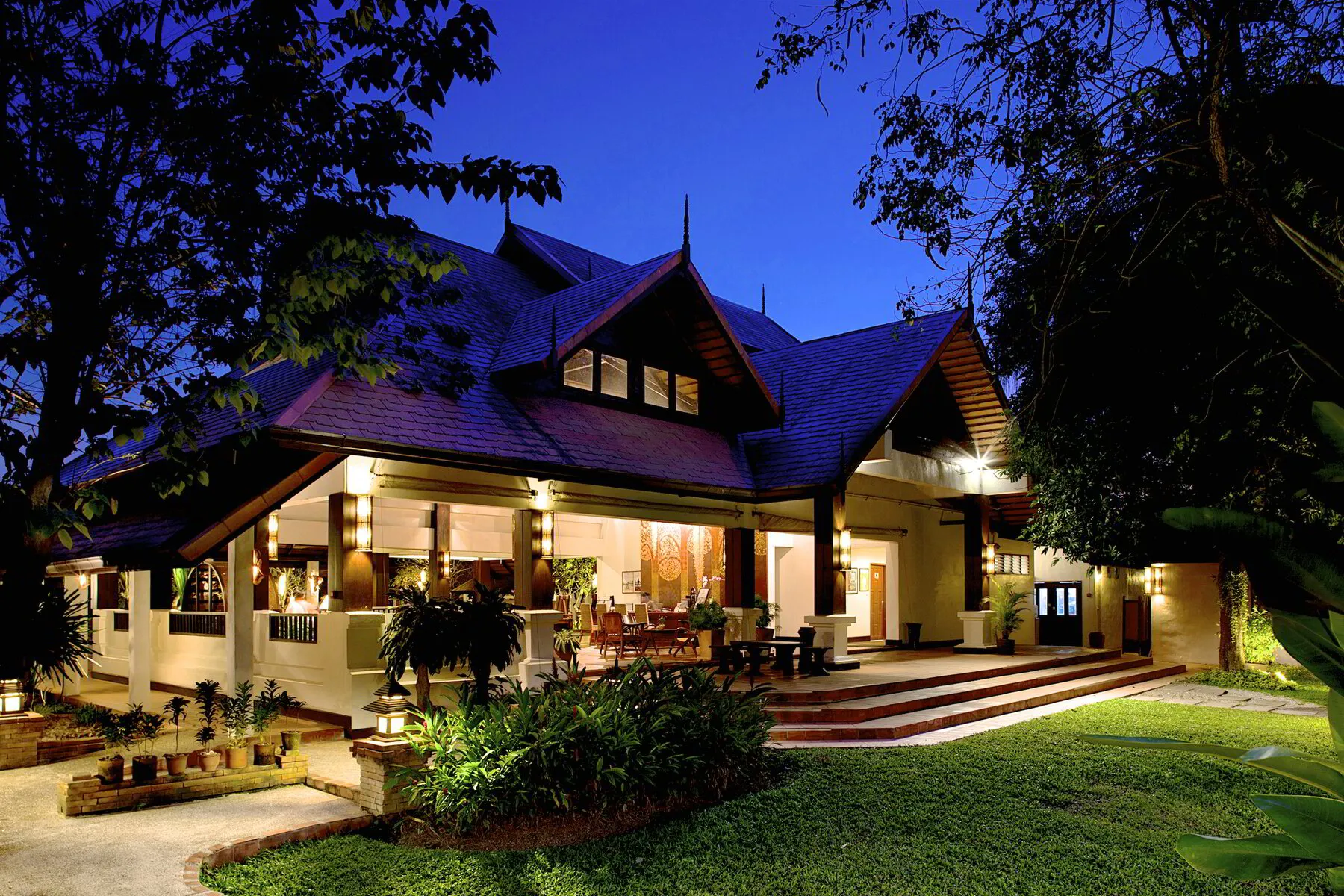
Stay: The Legend Chiang Rai Boutique River Resort & Spa Relaxed riverside resort

Getting there: AirAsia has 41 flights every week to Chiang Rai [more about AirAsia]

Find more activities and adventures in Chiang Rai at www.thailand.net.au

TOP FIVE ATTRACTIONS IN CHIANG RAI

- The White Temple (Wat Rong Khun): This iconic temple is a must-visit, famous for its unique blend of traditional Thai architecture and surreal, modern art. Its construction began in 1997, and it's still a work in progress 

Wat Rong Suea Ten (c) Roderick Eime 2022

- The Blue Temple (Wat Rong Suea Ten): Another stunning temple, known for its vibrant blue hues and intricate details. The temple's design is a mix of traditional Thai and modern art, making it a fascinating visit 
- Wat Phra Kaew: This historic temple is home to a replica of the famous Emerald Buddha, which is now housed in Bangkok's Grand Palace. The temple's architecture and tranquil atmosphere make it a great place to explore 
- The Golden Triangle: This historic area marks the confluence of the Mekong River and the borders of Thailand, Laos, and Myanmar. It's a great spot to learn about the region's history and take in the stunning views 
- The Night Bazaar: For a taste of local culture and shopping, head to the Night Bazaar, which takes place every evening. You can find everything from souvenirs and clothing to street food and local handicrafts